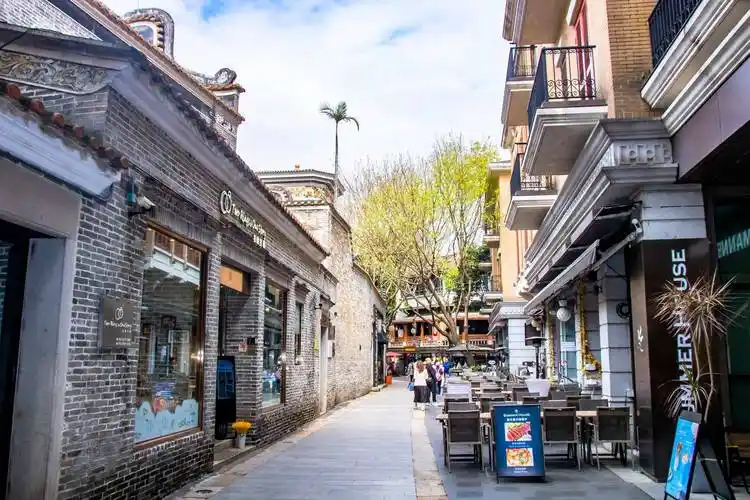
Foshan Lingnan Tiandi is a dynamic cultural district where history and modernity converge. Rooted in Lingnan architectural aesthetics, it weaves century-old arcade buildings with creative markets into a dialogue across time and space. Amidst grey brick walls and dark-tiled roofs, traditional "wok-ear" gables—distinctive stepped roof parapets—frame contemporary light installations, while the intricate lime sculptures adorning these walls come alive with stories of Lingnan merchant guilds under the night sky.
More than just a commercial hub, Lingnan Tiandi functions as a living laboratory for intangible cultural heritage. Cantonese opera masks, Shiwan ceramic sculptures, and Lingnan embroidery bloom at street corners, and the vibrant silk threads of Foshan’s traditional lantern-making intertwine with modern art exhibitions.
The core area is structured around “Three Streets and One Lane.” Yong’an Street showcases a cluster of restored wok-ear houses, recreating the residential-commercial ambiance of the Qing dynasty, while the water curtain wall at Lingnan Tiandi Plaza mirrors the refined landscaping of classical Lingnan gardens. Inside the cultural center, woodblock prints of Foshan New Year paintings are animated through digital projections, and the historic site of the Qixin Silk Mill—founded by Chen Qi Yuan, a pioneering industrialist of modern China—has been transformed into an industrial-chic creative space. Strolling along the cobblestone paths, visitors encounter the meticulously restored former residence of Wong Fei-hung, the legendary martial artist, and can pause to listen to the lingering vocal melodies of Ma Shi Zeng, a master of Cantonese opera.
Born during the Ming and Qing dynasties—a golden age of commerce—this district embodies the Lingnan merchants’ ethos of “pragmatism and enterprise.” As the dappled light filtering through traditional Lingnan lattice windows falls upon the glass façades of modern cafés, a delicate balance between tradition and contemporaneity emerges, eloquently expressing Foshan’s urban character: “built on commerce, sustained through culture.”