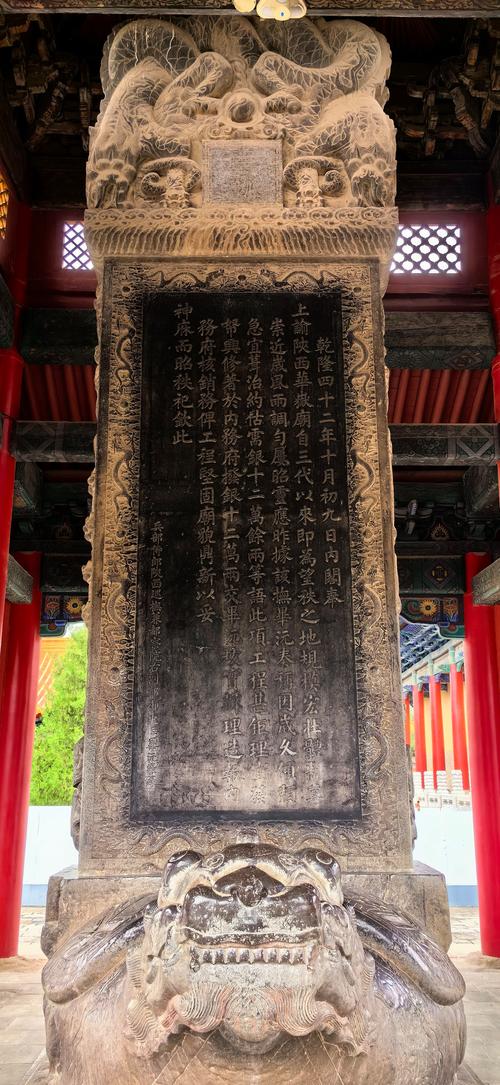
The West Lake Temple, established during the Tang Dynasty, is a thousand-year-old temple dedicated to the gods of Hua Shan. Its architectural complex is built along the mountain’s contours, with a central axis running north-south, featuring nine courtyards that progressively deepen. The towering “Hua Shan God Image,” cast in bronze, stands before the main hall, exuding majesty and solemnity. Alongside, stone carvings of the “Hua Shan Record” detail the mountain’s scenic wonders, inspiring reverence. The temple houses extant Ming and Qing inscription halls, displaying calligraphy from prominent figures like Su Shi and Wen Tianxiang, with vigorous brushstrokes narrating centuries of literary tradition. The core area centers around Yu Huang Dian, where a paved square is laid with blue stone, and during auspicious days, the temple is filled with incense smoke. East and west auxiliary halls house deities such as Sun Simiao and Guan Yu, while vibrant painted murals showcase the fusion of Daoist beliefs and folk faith. Hidden in the rear mountains is the “Taiyi Palace” site, once a place of Daoist practice, with ancient wells and stone scriptures still whispering of a bygone era of seclusion. As a significant sacrificial site within the Qinling Mountains, Xiyue Miao has long been a pilgrimage destination for scholars and poets. Li Bai left his famous poem, “Xiyue Zhenhong He Zhuang Cai,” here, and the travelogue of Xu Xiake further enhanced the temple’s renown. The temple embodies the essence of Chinese mountain worship, with every brick and stone reflecting a profound respect and praise for nature.