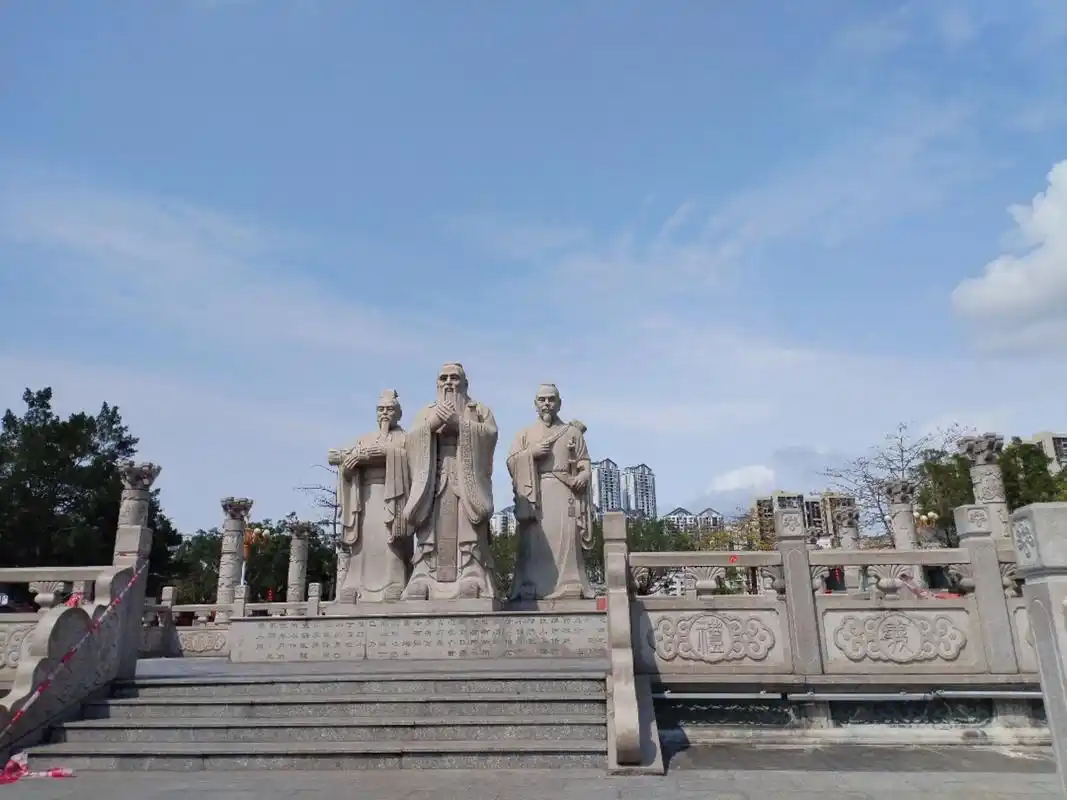
Lianzhou Confucian Temple, located in Lianzhou, Qingyuan, is the best-preserved Confucian temple in Lingnan. Its simple yet elegant appearance and solemn atmosphere resemble a frozen epic of Confucianism. The temple follows a symmetrical layout along a central axis, featuring three successive courtyards. Architectural elements such as the Lingxing Gate, Dacheng Hall, and Minglun Hall are arranged harmoniously amidst grey bricks and dark-tiled roofs, embodying over a thousand years of scholarly tradition. Particularly precious are the more than 30 stone steles preserved within the temple, dating from the Song to the Qing dynasties. Among them is the plaque inscribed with “Dao Qia Da Tong” (“The Way Harmonizes All Under Heaven”), written by Zhang Shichang, a Ming dynasty official, whose vigorous brushwork powerfully conveys the essence of Confucian thought.
Passing through the Lingxing Gate, visitors encounter lifelike stone lions on either side, and above the gate, the bold characters “Wen Miao” (Temple of Culture) command attention. The Dacheng Hall, crowned with a double-eaved hip-and-gable roof, houses a statue of Confucius, flanked by twelve statues of his esteemed disciples, all exuding dignity and reverence. Before the hall stands the “Wan Shi Shi Biao” (“Model Teacher for Ten Thousand Generations”) stele, its inscription still clearly legible despite centuries of weathering. The “Li Men Yi Lu” (“Gate of Propriety, Path of Righteousness”) archway before the Minglun Hall symbolized the moral cultivation and lofty aspirations of ancient scholars. In the rear courtyard, the Chongsheng Shrine preserves intact Confucian sacrificial rituals; amid the resonant tones of the guqin, one can almost hear the lingering echoes of lectures by Zhu Xi, the renowned Southern Song Neo-Confucian philosopher.
Originally built during the Xianchun era of the Southern Song dynasty, this temple once served as the center of Confucian learning in Lingnan. Wen Tianxiang, the famed Southern Song general who resisted the Yuan invasion, once lectured here, and his legacy of “authentic scholarship” profoundly shaped the scholarly ethos of the region. More than just a witness to the transmission of Confucianism in Lingnan, the temple stands as a cultural bridge linking past and present—each brick and stone quietly narrating the timeless wisdom of “cultivating oneself, regulating the family, governing the state, and bringing peace to the world.”