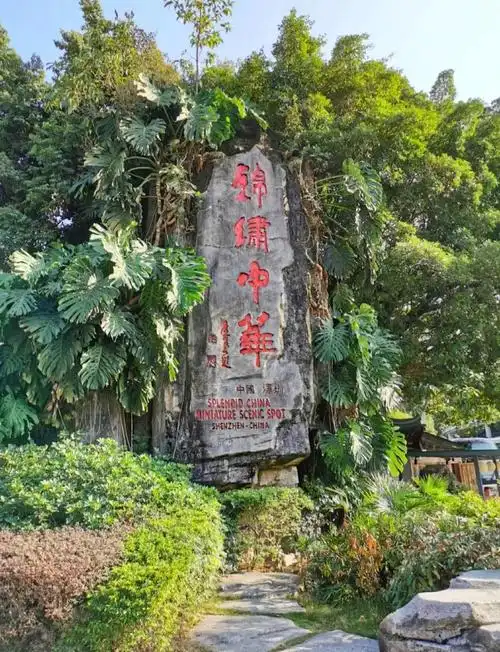
Shenzhen Folk Culture Village is a living museum of Lingnan culture, modeled after 24 traditional villages and encapsulating the architectural wisdom of Hakka walled houses, Chaoshan ancestral halls, and Cantonese dwellings. Stepping into the village, one senses the breath of millennia-old folk traditions among grey bricks and dark-tiled roofs. The yellow earth walls and oyster-shell walls of Hakka walled houses speak of resilience against foreign invasion; the “Four-Point Gold” layout of Chaoshan ancestral halls subtly embodies the continuity of clan lineage; and the intricately carved latticed windows of Cantonese arcade buildings reflect the imprint of thriving commerce.
The village features three thematic zones: In the Hakka area, the “Dafu Di” residence showcases gentry elegance through its distinctive curved gable walls (“guo’er qiang”); in the Chaoshan zone, the “Xia Shan Hu” hall displays exquisite ceramic mosaic art; and in the Cantonese section, the famed “Three Carvings and One Sculpture”—wood carving, stone carving, and lime plaster sculpture—demonstrate masterful craftsmanship. Visitors can participate in intangible cultural heritage experiences such as Hakka bamboo weaving, Chaoshan Yingge dance, and Cantonese opera, while savoring the evocative aromas of “homesickness on the tongue”: Hakka lei cha (pounded tea), Chaoshan gongfu tea, and Cantonese dim sum.
This land once served as a stronghold for Zheng Chenggong (a Ming–Qing transition military leader) in his resistance against the Qing dynasty, and echoes of Lin Zexu’s (a Qing dynasty statesman) opium destruction at Humen still linger. Today, the Folk Culture Village is more than an exhibition of architectural art—it is a vibrant embodiment of the Lingnan people’s spiritual heritage, where every wall and window becomes a cultural cipher bridging past and present.