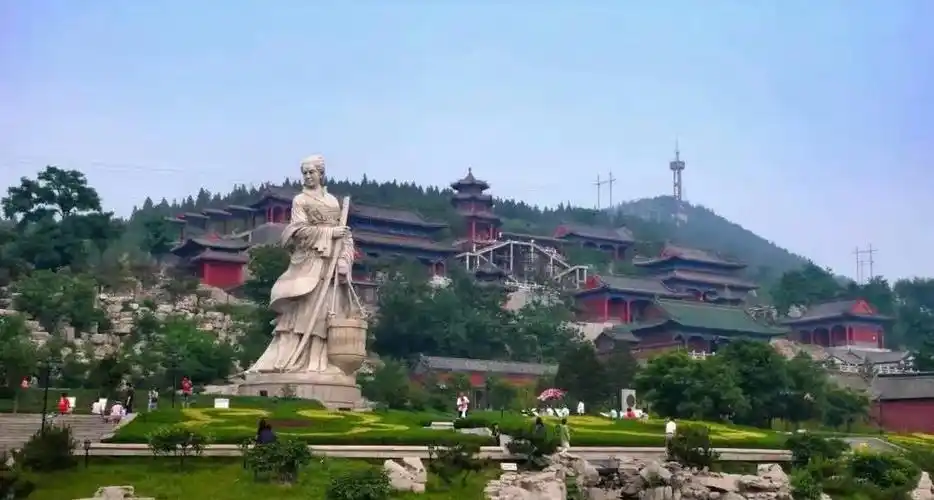
The Yan Wenjiang Temple is located in Linzi District, Zibo, and stands as the best-preserved relic of filial piety culture in central Shandong. Originally built during the Spring and Autumn Period, it has withstood over a millennium of wind and rain yet remains solemn and dignified. Within the temple complex, Song dynasty stone carvings harmonize beautifully with Ming- and Qing-era architecture. The essence of Song wooden craftsmanship endures in its sweeping eaves and interlocking brackets, while verses inscribed by literati of the Ming and Qing dynasties grace its grey bricks and dark-tiled roofs. In the courtyard, ancient cypress trees stand evergreen, and beside them lies a thousand-year-old well—its stone rim etched with weathered prayer marks left by generations of devoted pilgrims.
The centerpiece of the main hall is a lifelike statue of Yan Wenjiang, her gentle countenance and flowing robes rendered with remarkable realism. Before the hall stands a forest of stone steles, among which the Song dynasty “Stele Inscription of Yan Wenjiang Temple” is especially notable for its bold, vigorous calligraphy recounting the legendary tale of this Spring and Autumn–era woman from the State of Lu whose filial devotion moved heaven itself. Inside the temple, Ming dynasty polychrome murals vividly depict scenes of Yan Wenjiang serving her in-laws and weaving to support her household—brilliant in color yet bearing the marks of time. Particularly striking are the stone guardian beasts before the temple entrance: their simple yet exquisitely carved forms offer invaluable specimens for studying Song dynasty stone sculpture.
Yan Wenjiang, a native of the State of Lu during the Spring and Autumn Period, became renowned for her extraordinary filial piety. After her husband Yan Gao died young, she single-handedly raised their unborn child and, through extreme frugality, cared devotedly for her aging in-laws—an act of virtue that eventually inspired admiration throughout her community. During the Tang and Song dynasties, successive emperors promoted filial piety as a cornerstone of governance, leading to repeated renovations of the temple, which thus became a living embodiment of Confucian filial values. To this day, the temple preserves intact ancestral rites: offerings of the "three sacrificial animals" and "five grains," accompanied by curling incense smoke, continue to ritualize and immortalize the spirit of filial devotion across millennia.