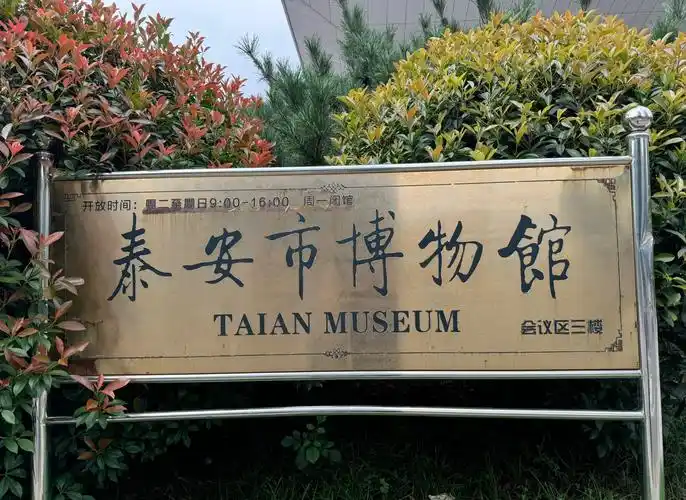
Located at the foot of Mount Tai—the foremost of China’s Five Great Mountains—the Tai’an Museum is renowned for its profound cultural heritage and rich collection of artifacts.
The museum’s Bronze Gallery houses treasures from the Shang and Zhou dynasties, including a Shang-Zhou period ding vessel adorned with taotie motifs and a Western Zhou zun vessel decorated with zoomorphic patterns. Their dignified forms and exquisite ornamentation reflect ancient people’s reverence for heaven and earth. The Han Dynasty Terracotta Figurines Gallery features realistic depictions of chariots, horses, and ceremonial processions; their flowing robes seem still imbued with the graceful spirit of Han-era aesthetics.
The Mount Tai Stele Gallery functions as an open-air corridor of calligraphy, displaying inscriptions by literati and poets across dynasties like stars scattered across the heavens. Particularly notable are the powerful characters “Mount Tai” inscribed by Su Shi, a famed Northern Song dynasty writer, which stand in harmonious contrast to Emperor Qianlong’s (Qing dynasty) imperial inscription “Peerless Among the Five Sacred Peaks.”
A special exhibition titled “Treasures of Imperial Fengshan Rituals” showcases relics such as the stele erected by Qin Shi Huang (First Emperor of the Qin dynasty) during his eastern tour and rubbings of the Fengshan stele commissioned by Emperor Wu of Han (Western Han dynasty), testifying to the millennia-old tradition of emperors ascending Mount Tai to perform sacred Fengshan ceremonies. Within a display case stands a fragmented bronze statue of Confucius (the Spring and Autumn period philosopher), gazing eternally toward the endless slopes of Mount Tai—a silent testament to the deep integration of Confucian thought with the spiritual essence of the mountain.
The museum also preserves original manuscripts of Mount Tai-themed poetry by Dong Qichang, a celebrated Ming dynasty calligrapher, whose brushstrokes convey profound reflections on nature and humanity. Each artifact serves as a messenger traversing time, guiding visitors back to that luminous era of ritual, music, and civilization.