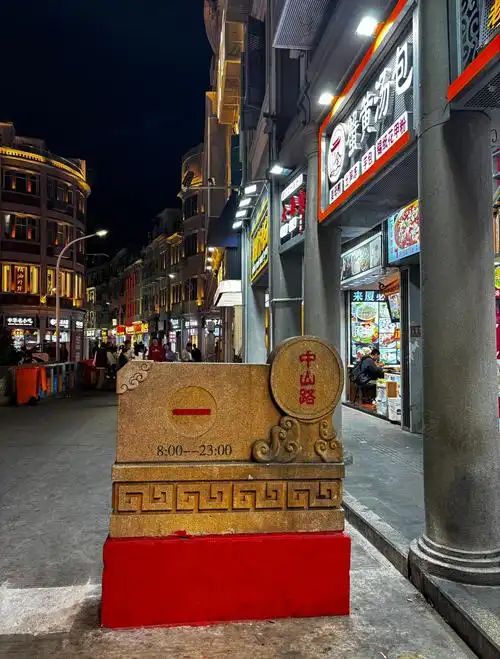
Quanzhou’s Zhongshan Road Pedestrian Street is a living museum of southern Fujian’s thousand-year-old commercial heritage, where cobblestone paths wind through centuries of mercantile legend. Elegant arcade buildings, blending Chinese and Western architectural styles with exquisite craftsmanship, trace the contours of time, their shaded arcades resonating with the ancient melodies of Nanyin music and the vibrant bustle of everyday life.
Time-honored shops line the street: the Zhonglou Herbal Pharmacy, founded by a renowned Qing-dynasty physician, continues to prepare remedies using traditional methods, while Yuanhe Tang Herbal Shop—established by a Qing-era apothecary—still fills the air with the delicate fragrance of angelica and astragalus. In the creative market stalls, traditional puppet-theater masks meet modern Citong-red tote bags, sparking a dialogue between heritage and contemporary design.
At the heart of the district stands the Overseas Chinese Museum, housing precious artifacts donated by patriotic overseas Chinese leader Lee Kong Chian, embodying the nostalgic memories of generations of diaspora. Nearby, the Laojun Rock cliff carving beneath the East and West Pagodas silently witnesses Quanzhou’s glorious past as a key port on the Maritime Silk Road. Around the corner, a Liyuan opera stage presents the lyrical aria of “Chen San and Wu Niang,” while steaming bowls of mianxianhu (vermicelli soup) at roadside stalls emanate the warmth of Minnan people’s zest for life.
This street, once echoing with the anti-Qing resistance led by Zheng Chenggong—a famed military leader of the late Ming and early Qing dynasties—is now celebrated as “Southern Fujian’s Premier Street.” Here, millennia-old merchant culture, Nanyin music, puppet theater, and other intangible cultural heritages are seamlessly woven into modern consumer experiences. As sunset gilds the arcades in golden light, the pedestrian street transforms into a luminous corridor of culture, inviting every passerby to feel the rich, textured fabric of Quanzhou—the “Museum of World Religions.”