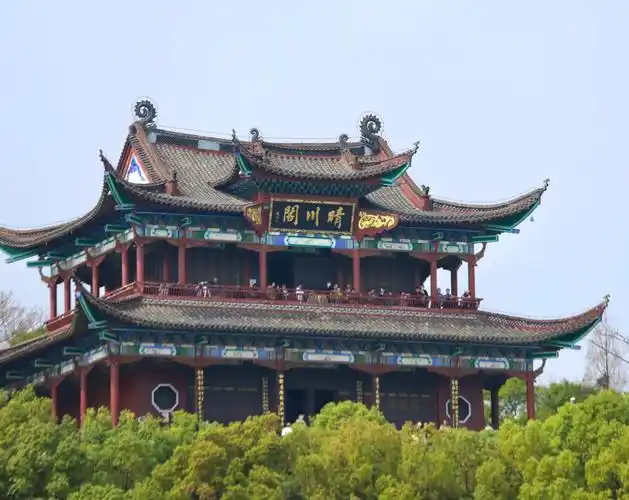
Perched on the banks of the Yangtze River in Wuhan, Qingchuan Pavilion is a cluster of Ming-dynasty pavilions famed for its poetic scenery evoked by the verse "clearly visible trees of Hanyang line the sunny riverbank." Together with Yingwu Island Ecological Park, it forms a living ink-wash scroll painting. The site is distinguished by the harmonious integration of ancient architecture and natural landscape. Its main surviving structures include Qingchuan Pavilion, Yuji Hall, and Tiejian Gate, whose upturned eaves and ornate rooflines play delightfully against the river’s shimmering surface, while ancient verdant trees whisper tales of history’s weight.
Ascending the pavilion offers sweeping views: the misty expanse of Gui Hill in Hanyang stretches into the distance, while Yangtze River ferries weave busily below—bringing vividly to life the poetic imagery of “lush fragrant grasses covering Yingwu Island.”
Originally built during the Jiajing era of the Ming dynasty as a military watchtower, Qingchuan Pavilion was later restored and transformed into a gathering place for poets and scholars. Inside Yuji Hall, an array of historic stone inscriptions is displayed, among which the stele bearing the famous lines by Tang-dynasty poet Cui Hao—“The man of old has already ridden the yellow crane away”—is especially treasured. This inscription resonates poetically with Li Bai’s (another Tang-dynasty poet) celebrated verse, “Clearly visible trees of Hanyang line the sunny riverbank,” together weaving Wuhan’s dual literary legends. Tiejian Gate, meanwhile, showcases the ingenuity of Ming-era defensive architecture, its stone-carved couplet reading “Iron-clad Golden City” echoing memories of past battles and smoke-filled days.
More than just a landmark of Yangtze River culture, Qingchuan Pavilion embodies the poetic spirit of Chu heritage. Every aged brick is steeped in the lyrical essence of “Qingchuan,” and every breeze off the river carries the lingering echoes of a thousand-year cultural legacy—leaving visitors enchanted and reluctant to depart.