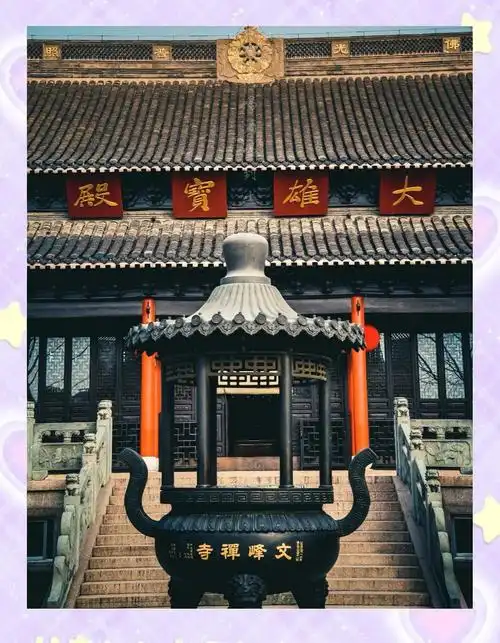
Wenfeng Temple was first built during the Zhenguan era of the Tang Dynasty and is among the oldest extant Buddhist temples in Yangzhou. Within its grounds stands the seven-story, pavilion-style Wenfeng Pagoda, constructed of brick. The pagoda’s eaves and bracket sets are arranged with graceful asymmetry; copper bells at its summit chime softly in the breeze, harmonizing with the winding nine-turn corridor and rockeries before the temple to create a poetic scene reminiscent of the verse: “The slanting shadow of the pagoda crosses the water, as moonlight sinks beneath its surface.”
Preserved within the temple are the Song Dynasty stone carvings of the *Wenfeng Tuzhi* (Illustrated Records of Wenfeng) and a Ming Dynasty imperial plaque inscribed with “One of the Ten Zen Monasteries.” The scripture library, shaded by ancient cypress trees, houses a rare woodblock edition of the *Tripitaka*, its yellowed scrolls still seeming to echo with the lingering resonance of sutra chants.
Walking along the central axis paved with bluestone slabs, one encounters the “Wenfeng Cauldron” before the Mahavira Hall, cast with seal script characters depicting the “Ten Scenic Views of Yangzhou.” Inside the hall, the eighteen arhats appear strikingly lifelike, particularly the awe-inspiring statue of Skanda (Weituo), who holds a sutra scroll in his hands. To the west of the temple lies Tingyu Pavilion (“Listening-to-Rain Pavilion”), once a gathering place for Qing Dynasty literati. On the surviving “Listening-to-Rain Stone” is carved the four-character inscription “Clouds, Waters, Chan Mind,” written by Zheng He, the famed Ming Dynasty navigator.
Each Qingming Festival, the temple hosts the “Chan and Tea as One” event, drawing descendants of the literati—those poetic souls once inspired by Su Shi’s famous line comparing West Lake to Xi Shi—to trace their cultural roots here.
Spanning over a millennium, this ancient monastery served not only as a crucial stop along Buddhism’s eastward transmission route but also as a living testament to the fusion of Yangzhou’s salt-merchant culture and scholarly refinement. Amidst the swaying shadows of the pagoda, one can almost glimpse the great Tang monk Jianzhen striding across the waves, imprinting the grandeur of the High Tang era into every gray brick and dark-tiled roof.