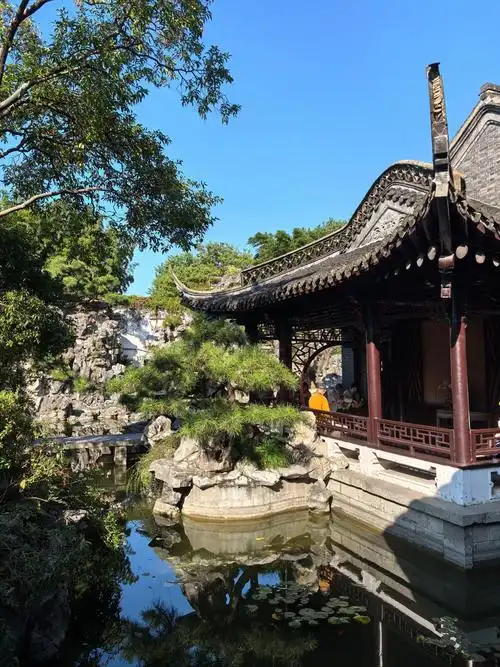
Located beside the Slender West Lake in Yangzhou, He Garden is a private garden meticulously crafted by He Zhidao—a salt merchant of the late Qing Dynasty—after his retirement from public life. It is acclaimed as the "finest garden of the late Qing era." At its heart lies the Pian Shi Shan Fang (Rockery Studio), where Taihu limestone rocks are artfully piled into artificial hills, complemented by winding bridges and flowing streams, perfectly embodying the classical Chinese garden ideal of "mountains and forests within arm's reach."
The garden features an innovative "double-sided lattice window" design: maintaining visual openness while allowing visitors to admire ever-changing views through the latticework, creating a dynamic visual feast where every step reveals a new scene.
At the garden’s center stands the Shuixin Pavilion (Pavilion on the Water), the highlight of the entire complex. From its stone table, one can take in panoramic views of the garden, where reflections in the water merge seamlessly with the real scenery, evoking the ethereal beauty of a traditional ink-wash painting. The surrounding corridors employ the "changing scenery with every step" technique; as visitors stroll along, different vistas peek through intricately carved lattice windows, subtly echoing the garden philosophy of "the moon arrives, the breeze comes"—a harmony between nature and human sensibility.
Within the garden are treasured artifacts, including a plaque inscribed with "He Shi Yuan" (He Family Garden) in He Zhidao’s own calligraphy, and a stone carving bearing the famous line "Pure breezes and bright moonlight are priceless," inscribed by Zheng Banqiao, the renowned Qing Dynasty painter. These elements reflect the refined aesthetic tastes of literati and scholars.
As a pinnacle of late Qing salt-merchant culture, He Garden not only showcases the exquisite craftsmanship of Jiangnan-style gardens but also embodies the merchant class’s spiritual pursuit of “conveying moral values through culture.” Its architectural ensemble blends the graceful delicacy of Suzhou-style gardens with the elegant dignity of Huizhou architecture. Remarkably well-preserved, it retains the complete layout of a late Qing salt merchant’s residence, serving as a vital physical testament to the interplay between classical Chinese garden art and commercial culture. Every Taihu stone and every carved window lattice silently narrates the aesthetic legacy jointly shaped by scholars and merchants of that era.