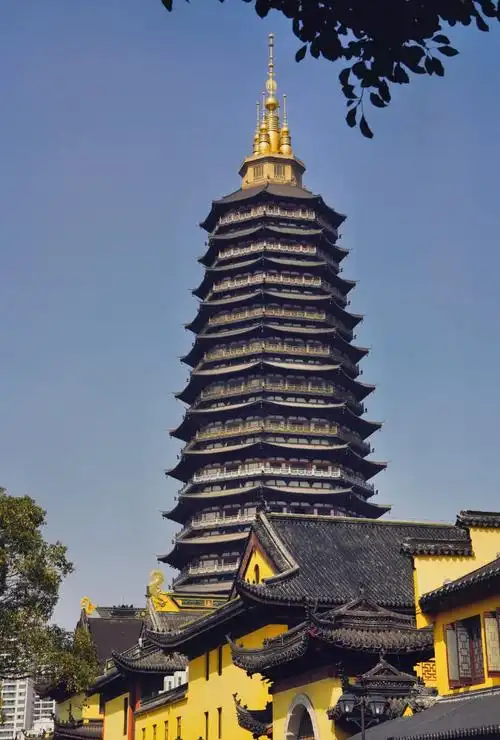
Changzhou Tianning Temple was originally built during the Zhenguan era of the Tang Dynasty. This millennium-old Buddhist monastery nestles against the mountainside, where upturned eaves and Buddhist culture harmoniously blend. An ancient ginkgo tree over a thousand years old stands within the temple grounds—its gnarled, dragon-like branches casting golden leaves that flutter like radiant halos of the Buddha, while swirling incense smoke carries the profound serenity of a thousand years of Zen contemplation.
The temple complex preserves several historic structures, including the Mahavira Hall, Scripture Repository Pavilion, and Guanyin Hall. Within the Scripture Repository Pavilion rests a surviving fragment of the Ming Dynasty's Yongle Encyclopedia (Yongle Dadian). Hidden among intricately carved beams and painted rafters are vivid Song Dynasty murals, and exquisitely rendered celestial nymphs adorn the caisson ceiling, playfully echoing Chan Buddhist verses.
Beneath the ancient ginkgo, flagstones pave the courtyard. The tree’s canopy spreads like an umbrella, its roots tracing back to the High Tang period. Its weathered bark bears countless inscriptions left by visitors across dynasties; among them, the four characters “Xin Deng Chang Ming” (“The Mind’s Lamp Shines Forever”), inscribed by Wen Tianxiang—the famed Southern Song general who resisted the Yuan invasion—stand out for their bold, powerful strokes.
Stelae stand densely throughout the temple grounds. Above the main gate still hangs the plaque inscribed with “Tianning Chan Temple,” calligraphed by Zhang Zaixin, a renowned Qing Dynasty calligrapher, whose brushwork remains as vigorous and iron-strong as ever.
Tianning Temple once served as a major center for the Fayan school of Chan Buddhism. The eminent Chan master Fayan Wenyi preached here, and his influential doctrine of “Everything is already complete” left a lasting impact on Chan thought. Despite enduring wars and dynastic upheavals, the temple retains Ming-era steles commemorating its reconstructions, testifying to Changzhou’s unbroken cultural lineage. Here, Chan Buddhist heritage and the aesthetics of Jiangnan garden design merge in perfect harmony, captivating every visitor who steps through its gates.