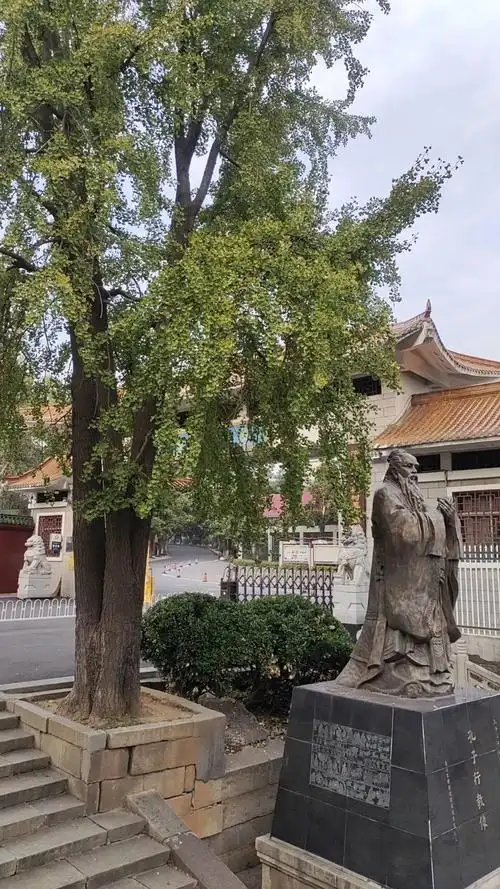
Yuezhou Confucian Temple was first built during the Qingli era of the Northern Song Dynasty. Having undergone numerous restorations over the centuries, its current architectural complex retains a foundation of Song-style design, enriched with the refined craftsmanship of the Ming and Qing dynasties, creating a unique and timeless classical ambiance. At its heart stands the majestic Dacheng Hall—solemn and dignified—with its double-eaved roof featuring nine ridges soaring gracefully skyward. Inside, a wooden statue of Confucius is enshrined, flanked by statues of the Four Correlates and the Twelve Philosophers. Carved onto bluestone steles, passages from the Analects remain remarkably legible despite enduring a millennium of wind and frost.
The Lingxing Gate is adorned with auspicious clouds and mythical beasts, symbolizing the flourishing of literary and scholarly fortune. Within the Minglun Hall, surviving fragments of the "Gazetteer of Yuezhou Prefecture" chronicle the imperial examination journeys of scholars from the Hunan region. Ancient cypress trees stand verdant throughout the temple grounds, while corridors lined with stone stelae display countless inscriptions—the most striking among them being the plaque reading "Hall of the Cultural Sage," calligraphed by He Shaoji, a renowned Qing-dynasty calligrapher.
This sacred site, which has carried forward the torch of Confucianism for generations, once served as a lecture hall for Zhang Shi, founder of the Huxiang School of Thought, where his philosophical idea—"All things are complete within me"—took root and flourished. Following the traditional layout of "temple on the left, school on the right," the temple complex seamlessly integrates the Confucian shrine with the Yuezhou Academy, embodying the Huxiang scholarly ethos of "practical learning for societal benefit."
During grand ceremonies honoring Confucius, the resonant sounds of drums and music fill the air as students clad in Hanfu perform ritual bows—an evocative moment that seems to bridge past and present, allowing participants to commune with a thousand-year-old cultural legacy. More than just a sanctuary for venerating Confucius, this temple stands as a spiritual emblem for Huxiang scholars, embodying their unwavering commitment to moral cultivation. Its profound message of "revering culture and valuing education" continues to echo across the shores of Dongting Lake to this day.