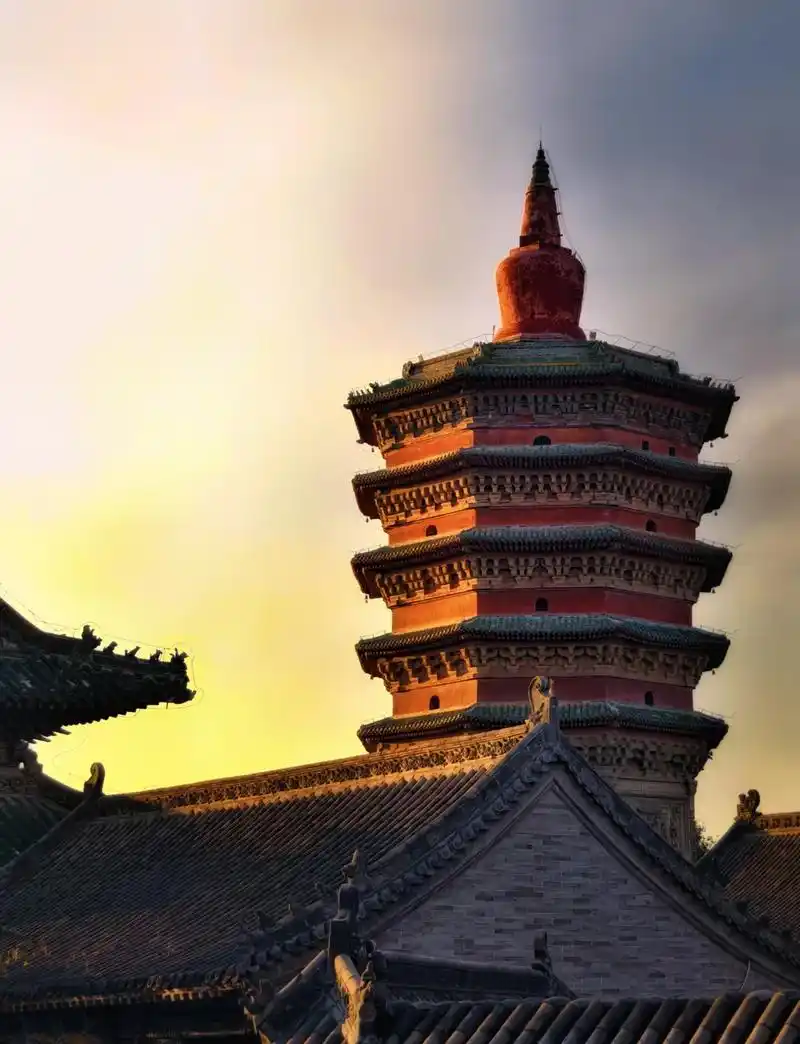
The Wenfeng Pagoda in Anyang stands tall and majestic on the banks of the Huan River, representing the most iconic ancient architectural relic in northern Henan. This seven-story pavilion-style pagoda features timber-framed imitation construction, with intricately carved beams and painted rafters beneath its soaring eaves and bracket sets. Glazed tiles embedded in the pagoda’s façade shimmer brilliantly under sunlight. From the summit, one can take in the misty expanse of the Huan River and the distant Taihang Mountains; the pagoda’s reflection in the water creates a breathtaking scene, as if time and space have folded into a single exquisite painting.
Inside the pagoda lies a collection of steles dating back to the Jiajing era of the Ming Dynasty. Among them, the inscription “Record of Wenfeng Pagoda,” with its vigorous calligraphy, documents the original purpose of its construction: to promote literary and scholarly prosperity. Vivid bas-reliefs depicting the “Twenty-four Filial Exemplars” adorn the pagoda walls, immortalizing Confucian values of loyalty and filial piety as enduring art. At the base of the pagoda, the Oracle Bone Script Rubbing Wall employs contemporary techniques to revive the legacy of the Shang Dynasty, engaging in a millennia-spanning dialogue with the Ming- and Qing-era carvings on the pagoda itself.
Originally built in the 27th year of the Jiajing reign (1548), this structure embodies the visionary foresight of Han Qi, a renowned statesman of the Northern Song Dynasty, who championed cultural and educational advancement. Its location was deliberately chosen to align with the feng shui principle of “Wenfeng Orientation”—a directional alignment believed to foster scholarly success. Bronze wind chimes atop the pagoda gently tinkle in the breeze, as if whispering the cultural DNA of Anyang, once the capital of the ancient Shang civilization. The word “Wenyun” (Literary Fortune), inscribed in seal script above the four doorways, together with nearby historical sites such as Yuanlin and the ruins of Zhangde Prefecture, collectively map out Anyang’s spiritual lineage of cultural continuity. As twilight bathes the pagoda’s spire, the entire structure transforms into a flowing waystation through time and space, bearing silent witness to the ceaseless vitality of Chinese civilization.