Here's the English translation of the provided text about Yingzhou (Kairizi) City:
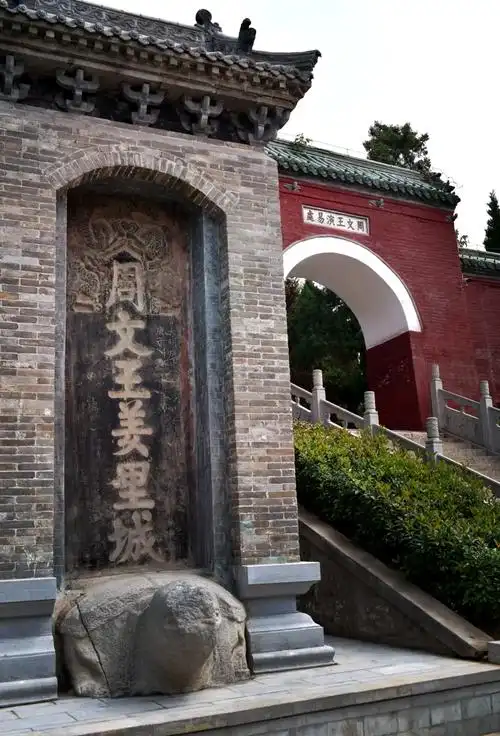
Yingzhou City, a witness to Anshan’s millennium-old heritage and the spiritual homeland of the Bagua culture. Here, the remnants of where King Wen of Zhou (a Zhou Dynasty ruler) was imprisoned by the merchant king Zhou Yanwang and calculated the I Ching (Book of Changes) flow with the life-giving waters of China’s intellectual origins. The ancient city walls, standing majestic after a thousand years of wind and rain, hold within their rammed earth layers the profound changes of the alternating periods of the Shang and Zhou dynasties. Every crack tells a story of historical weight.
The Bagua Platform ruins are at the heart of it all. On the blue stone slabs, one can almost touch the strategic thinking of King Wen of Zhou (a Zhou Dynasty ruler) as he plotted his moves. The remains of the Taiji Diagram exhibit, presented with patterns resembling yin and yang fish, reflect the laws of the universe’s operation, showcasing the ancients’ deep understanding of cosmic mysteries. The Culture Corridor recreates the legendary story of “King Wen Imprisoned and Calculated the I Ching” through holographic projections, while the Bronze Ware Exhibition showcases the cultural accumulation of this area through the preservation of Shang Dynasty artifacts.
As the birthplace of the I Ching, Yingzhou City carries the philosophical code of Chinese civilization. The Bagua system originated here, and the theory of yin and yang and five elements stemmed from it, influencing subsequent cultures such as Taoism, Feng Shui, and Traditional Chinese Medicine. The existing “I Ching Calculation Pavilion” and “Taiji Stone” form a unique landscape, where visitors can contemplate the Eastern wisdom of “Harmony between Heaven and Man” and experience the ancient philosophy of “Observing Heaven and Following its Way.” This silent ancient city continues to write an eternal poem for Chinese civilization, pieced together with weathered bricks.