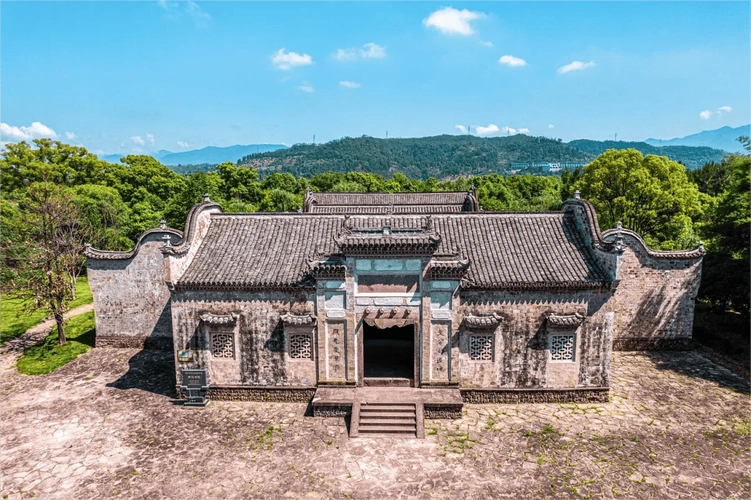
Tongjiang Academy in Fu'an was first established during the Qing dynasty and stands as one of the best-preserved ancient library buildings in eastern Fujian. Its grey bricks and dark-tiled roofs embody two centuries of scholarly heritage. Named after the local Tongjiang River, the academy symbolizes an unceasing flow of literary inspiration like river currents and enduring scholarly fragrance akin to the whisper of pine breezes.
The main structure comprises three courtyards. Beneath upturned eaves hangs a wooden plaque inscribed with "Echoes of Tongjiang," while weathered stone steps bear engraved verses by generations of literati—the most striking among them a stele reading "Scholarly Voices Accompanied by Cranes' Calls," evoking the resonant morning recitations of Qing-era students.
At the heart of the academy lies its library—a seven-story wooden pavilion housing over a thousand rare volumes, including surviving fragments of the Siku Quanshu (Complete Library of the Four Treasuries) and hand-copied local gazetteers. Among the bookshelves hang couplets penned by Qing scholars, such as "Collecting books is not merely about quantity; what truly matters is grasping their essence"—a maxim attributed to Huang Zongxi, a renowned Qing bibliophile.
The courtyard's "Tongyin Lecture Hall," originally used for scholarly instruction, still retains its original stone tables and benches, their surfaces faintly marked with ink inscriptions that testify to the vibrant intellectual debates once held by past scholars.
Historically serving as Fu'an's cultural and educational hub, the academy nurtured numerous successful imperial examination candidates, including Chen Baochen—a late-Qing reformist scholar who oversaw the compilation of the Fu'an Prefecture Gazetteer here. Beyond its role as a repository of books, the academy profoundly shaped Min Dong culture through its ethos of "revering literature and valuing education." Its architectural form and bibliophilic traditions offer invaluable insights into Qing-era academy systems, making it a living fossil of scholarly heritage. Today, walking through its halls, one can still sense the warmth of history and hear the echoes of ancient texts and intellectual legacy resonating across time.