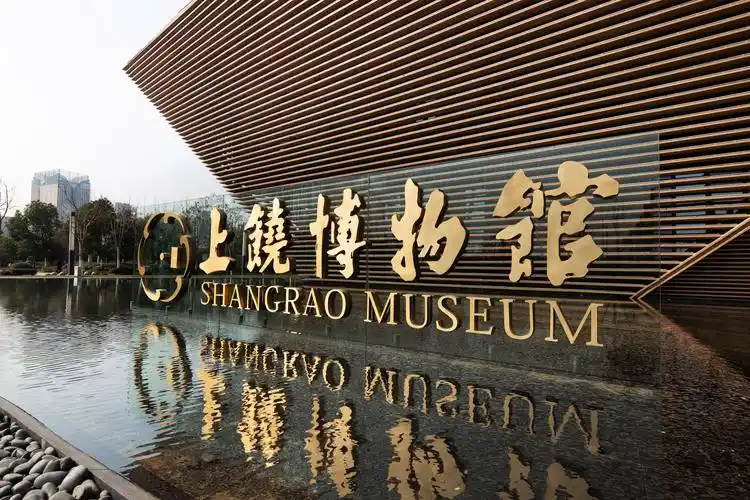
Positioned as "A Hidden Gem of Jiangnan, A Cradle of Culture," the Shangrao Municipal Museum houses over 10,000 cultural relics, serving as a veritable genetic repository of northeastern Jiangxi's heritage. In the "Ancient Echoes of Mount Sanqing" exhibition hall, the museum displays the "Yiyang Tiger Tally," a bronze artifact from the Shang and Zhou dynasties, whose vivid taotie motifs exemplify the pinnacle of Shangrao’s ancient bronze-casting craftsmanship. The "Huizhou Style of Wuyuan" section showcases delicate blue-and-white porcelain from Ming and Qing dynasty folk kilns, their glazes lustrous as jade, capturing the millennium-long dialogue between the "Porcelain Capital" (Jingdezhen) and the "Tea Country" (Wuyuan).
The museum also features an innovative "Digital Archaeology" interactive zone, where holographic projections recreate the historic Shangrao post station along the Song Dynasty Tea-Horse Road. Visitors can touch replica copper bells once used by tea-horse caravans, evoking the resonant echoes of this ancient trade route.
In the "Xinjiang River Civilization" thematic gallery, a fragmentary copy of the Northern Song-era *Shangrao County Annals* and a Southern Song manuscript of the *Yiyang Collection* stand side by side, testifying to the enduring literary legacy of this land long celebrated for its "literary excellence and moral integrity." Among the treasures is a Ming-dynasty dragon-decorated bowl from the "Shangrao Kiln," its glaze smooth and creamy, bearing the engraved seal script characters "Yiyang" on its base—a testament to the city’s historical ties with Jingdezhen’s porcelain trade. The specially designated "Local Chronicles Hall" preserves a Qing-dynasty woodblock edition of the *Shangrao Prefecture Gazetteer*, its yellowed pages still revealing poetic depictions of the famed "Eight Scenic Views of Shangrao."
As a cultural landmark in eastern Jiangxi, the museum deeply explores the convergence of Xinjiang River culture and Wuyuan’s Huizhou heritage. On display is the "Yiyang Fire Attack Formation Map," once used by the Ming general Qi Jiguang [a renowned Ming military strategist], alongside the original manuscript of Wen Tianxiang’s [a celebrated Southern Song national hero and anti-Yuan commander] "Song of Righteousness," composed during his time in Shangrao. Together, these artifacts resonate across history, embodying the cultural character of this ancient Jiangnan city—steeped in literary tradition and unwavering moral fortitude.