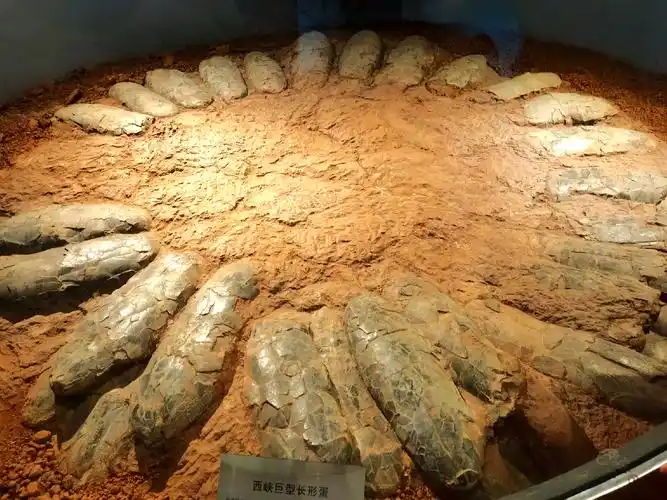
The Nanyang Dinosaur Egg Fossil Site, located in Xixia County of Nanyang City, is the world’s largest Cretaceous dinosaur egg fossil assemblage and has been hailed as “Earth’s prehistoric code.” The site preserves over 100,000 complete or partially intact dinosaur egg fossils, showcasing various shapes including oval and spherical forms. Some eggshells even contain embryonic fossils, offering a vivid glimpse into the mysterious reproductive lives of dinosaurs. Scattered across the scenic area like stars in a galaxy, these fossil clusters are embedded in mottled rock walls, preserving imprints of life from hundreds of millions of years ago—an awe-inspiring sight.
At the heart of the site lies the “Dinosaur Egg Fossil Cluster Protection Zone,” where exposed red sandstone serves as a natural canvas. Layer upon layer of fossilized eggs resemble the growth rings of the Earth, chronicling geological changes from the Late Jurassic to the Early Cretaceous periods. Visitors can walk along biomimetic pathways to closely examine the intricate textures of eggshells or experience the grandeur of the dinosaur era through holographic projections in the “Corridor of Life Evolution.” On-site, the Dinosaur Egg Fossil Museum houses more than 300 exquisite specimens, including a striking exhibit featuring the skeleton of “Nanyangosaurus” displayed alongside its associated egg fossils—a compelling reconstruction of an ancient ecological chain.
Situated in the heart of Central China, Nanyang has long been recognized as a cradle of civilization. Zhang Heng, the renowned Eastern Han dynasty scientist, once observed celestial phenomena here. The discovery of dinosaur egg fossils has further endowed this land with profound scientific significance that transcends time and space. More than just a vital window into China’s paleontological research, the site functions as an educational sanctuary centered on the theme of “the origin and evolution of life,” bridging the ancient past with the modern world and allowing every visitor to marvel at nature’s extraordinary craftsmanship.