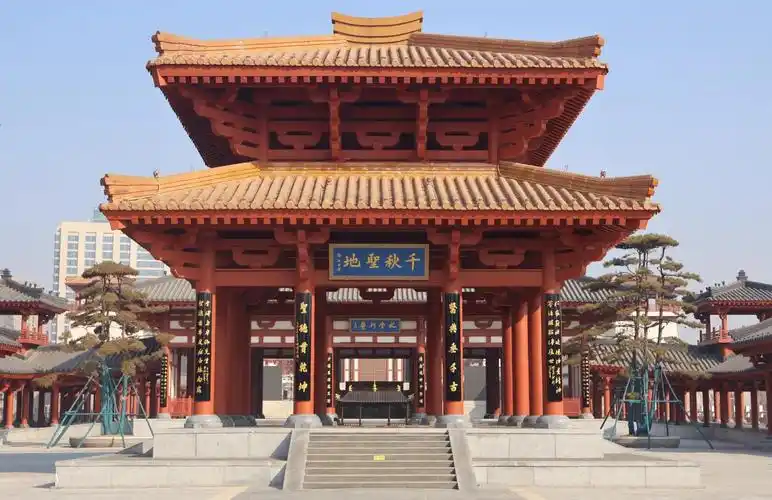
Located in Nanyang City, this temple was built to commemorate Eastern Han Dynasty medical scholar Zhang Jixing, is a significant landmark of traditional Chinese medicine culture in the Central Plains region. The inner ancient architectural complex is solemn and majestic, with the flow of thousands of years of medical knowledge inheritance, red walls and green tiles reflect the eternal light of a physician’s benevolence. The core scenic area centers around “Medical Sage Hall,” where a statue of Zhang Jixing holding the “Essentials of Treatise on Cold Diseases” stands, his gaze piercing and watchful. Inside the hall, ancient copies of the “Essentials of Treatise on Cold Diseases” from the Song Dynasty and Ming Dynasty pulse diagnosis instruments are displayed, showcasing the evolution of traditional Chinese medical literature. The backyard’s “Medical History Museum” recreates Zhang Jixing’s study scene through holographic projection, where he “sought ancient teachings and absorbed diverse opinions,” captivating visitors. The ancient cypresses in the temple are verdant and ancient, said to have been planted by Zhang Jixing himself, their bark mottled like ancient texts, witnessing the warmth of the medical profession. As a site for the inheritance of traditional Chinese medicine culture, Yishengci is not only a place of worship but also a living museum of traditional Chinese medicine knowledge. Visitors can touch the texture of the bamboo slips of the “Essentials of Treatise on Cold Diseases,” and listen to the rhythm of the holographic projection of the “Yellow Emperor’s Inner Canon” played on a guqin. Numerous inscriptions in the temple, written by Qing Dynasty officials, powerfully express the meaning of “benefiting the world with medicine.” This place is not only a memorial to Zhang Jixing, but also a symbol of the Chinese medical spirit. Stepping through the temple gates, one feels as if they have traveled through a thousand years, engaging in dialogue with the Medical Sage, experiencing the eternal questioning of “sincerity in medicine,” and witnessing the continuous transmission of Chinese medicine civilization.