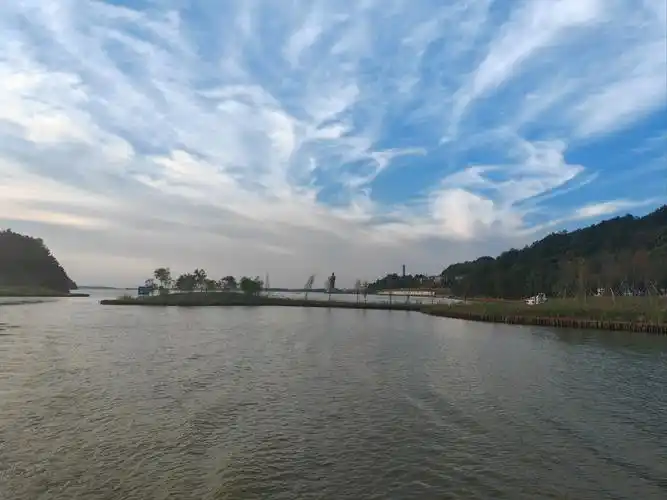
Poyang Lake, China's largest freshwater lake, spreads across northern Jiangxi like a jade platter, covering a total area of 3,960 square kilometers. It serves as a crucial stopover for migratory birds along the East Asian flyway. Every winter, hundreds of thousands of white cranes, swans, and cormorants gather here, creating a breathtaking spectacle as flocks take to the skies in unison. Gliding through reed beds in a traditional oar-powered boat, visitors can observe red-crowned cranes spreading their wings and swans playing in the water, while the lake’s surface mirrors drifting clouds and sky—a scene straight out of an ink-wash scroll painting.
Fishing chants from the ancient village of Wucheng—once a Southern Song dynasty lakeside post station—echo across the water. From the birdwatching platform at Xiangshan Wetland, one can gaze down upon a "Milky Way of migratory birds." At the lake’s outlet, Shizhong Mountain is famed for its extraordinary stalactite formations, and its ancient temple bears witness to the poignant legend of Wen Tianxiang, the heroic Southern Song general who resisted the Yuan invasion. The lake preserves a complete wetland ecosystem, where lush aquatic vegetation shelters rare species such as the Yangtze finless porpoise and the baiji (Yangtze River dolphin). Drifting among these waters, one truly senses the vastness captured in the phrase: “Where water and sky merge into boundless expanse.”
Historically, Poyang Lake served as a vital resupply port for Zheng He’s Ming dynasty maritime expeditions, forming part of the ancient “Golden Waterway.” Along its shores, fishing villages still maintain age-old customs, such as boatwomen singing folk songs while rowing. The Northern Song poet Huang Tingjian once composed here the celebrated verse: “Heavenly light and cloud shadows drift together in tranquil reflection.” As the sun sets, scattered fishing lanterns shimmer upon the lake, blending with the fading light to create a living landscape painting—offering visitors a vivid experience of why Poyang Lake is hailed as “The Greatest Lake Under Heaven.”