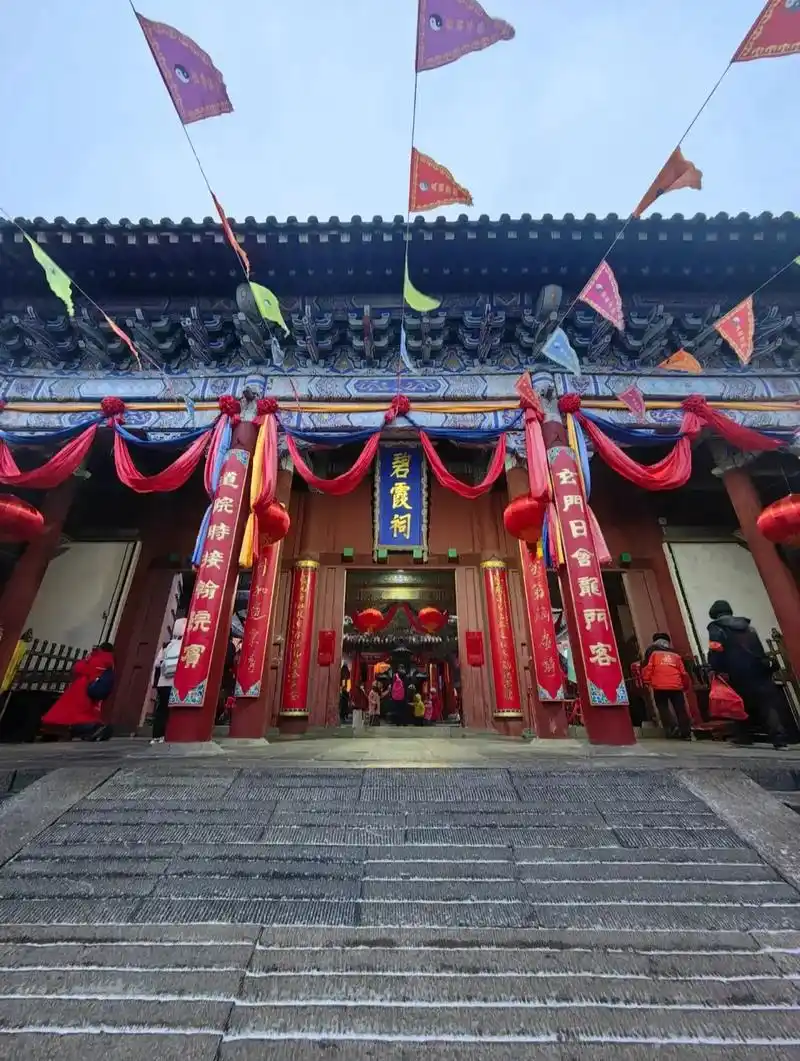
Established during the Qin and Han dynasties, this is the most famous goddess temple on Mount Tai. It has enjoyed continuous incense offerings for centuries, with the existing architectural complex following the mountain’s contours. The main hall houses the deity Biksha Yuanjun, with a surrounding of ancient cypress trees and a copper incense burner creating a hazy atmosphere. Visitors can hear the clear calls of birds among the branches, drawing pilgrims to gaze upwards. Numerous inscriptions are found within the temple, including a Qing Dynasty stone tablet detailing imperial ceremonies, with an inscription by the Qianlong Emperor, “Biksha Yuanjun’s Palace.” Ascending along the central axis, the side hall houses the deities Sendi Niu Niu (White Lion) and Biksha Yuanjun. Bronze bells chime gently in the breeze, resembling celestial music. In the western courtyard, the “Wanshui Bridge” (Ten Thousand Year Bridge) is constructed of blue stone, adorned with carvings of the Eight Immortals crossing the sea. The stream beneath reflects the bowing figures of pilgrims. Every fifteenth day of the third month of the lunar calendar, the Tai Shan Festival draws massive crowds, with red banners billowing, and incense coloring half of the mountain’s landscape. Pilgrims tie their wishes to prayer ropes, hoping for hundreds of descendants. Biksha Ci is not only a Taoist holy site, but also the spiritual totem of the Qi Lu culture. Since the Qin and Han dynasties, emperors, officials, and scholars have come here in droves, and Wen Tianxiang, a famous general during the Southern Song Dynasty, wrote poems here, leaving behind the verse “Before Biksha Ci, the cypress trees are verdant, and the mountain’s aura is deep.” This place carries the Chinese nation’s reverence for the fertility goddess, witnessing the joys and sorrows of countless families seeking offspring. The rings of the ancient cypresses are engraved with the unchanging password of faith.