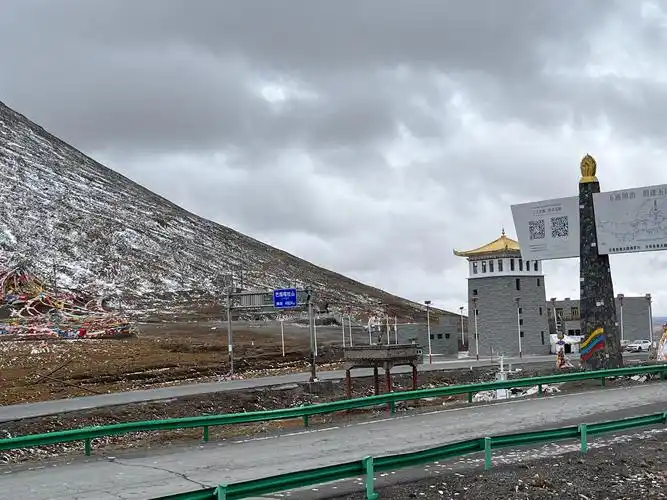
Bayan Har Pass lies southwest of Golmud City at an elevation of 4,571 meters, crowning the eastern edge of the Qinghai-Tibet Plateau as the apex of the snowline. Spectacular vistas unfold here in every season: in winter, the landscape is draped in silver, with glaciers like jade dragons coiling amid swirling snow mists, evoking a fairyland; in high summer, alpine wildflowers carpet the plateau—colorful gentians and snow lotuses bloom side by side, their vivid hues contrasting dramatically against the vast, snow-capped peaks.
Sheer cliffs flank the pass on both sides, and wind-eroded rock pillars stand like frozen moments in time. At sunrise, golden light pierces through the clouds, bathing the entire valley in amber—a sight that stirs the soul.
The heart of the scenic area comprises the "Snowline Col" and the "Sacred Lake Sanctuary." The former marks the ultimate challenge for mountaineers, while the latter harbors a glacial lake at 5,100 meters above sea level. Its mirror-like surface reflects the surrounding snow peaks, and prayer flags flutter vigorously along its shores. Local Tibetans call it "the Mirror of the Sky God."
In summer, visitors can trek across alpine meadows, occasionally spotting blue sheep leaping nimbly along cliff faces. Winter access requires specialized gear, with avalanche warning systems and oxygen supply stations ensuring safety.
Since ancient times, this pass has served as a vital node on the Tea-Horse Road. During the Tang dynasty, emissaries from the Tibetan Empire established a waystation here. The 18th-century *Golmud Gazetteer* records: "Bayan Har Pass is the gateway to the Kunlun Mountains." In 1930, the modern explorer and Republican-era general Huang Musong led an expedition through this pass; his diary entry—"snow peaks like clusters of silver, heaven and earth merged into one"—remains a treasured historical source for geographical studies.
At the pass stands a thousand-year-old mani stone pile, a testament to the wisdom of nomadic peoples living in harmony with nature. Each stone bears carvings expressing reverence for the sacred mountains and prayers for blessings.