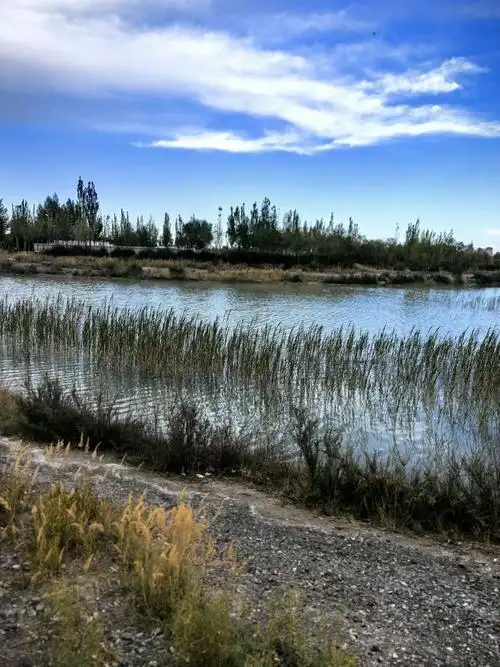
The Golmud River winds through the city like a jade-green ribbon, weaving desert and oasis into a symphony of life. At dawn, sunlight dances on its surface in shimmering gold, while snow-capped mountain reflections fracture into countless stars across the rippling water. At sunset, molten gold spills across the sky, transforming the entire river into flowing amber, harmonizing with the distant snow peaks of the Kunlun Mountains to paint an epic scroll spanning heaven and earth. The dramatic contrast between the Gobi desert and riverside oases creates the majestic scene immortalized in the ancient verse: “A solitary plume of smoke rises straight over the vast desert; the setting sun hangs round above the long river.” In autumn especially, golden poplar trees mirror themselves in the emerald waters, conjuring a dreamlike vision as if stepped out of Dunhuang murals.
The riverside oasis once served as a vital stop for caravans along the ancient Silk Road. The Tang dynasty poet Cen Shen paused here and composed the timeless lines, “A solitary plume of smoke rises straight over the vast desert; the setting sun hangs round above the long river.” Today, wetland parks and viewing platforms dotting the riverbanks have become secret havens for photographers chasing light and shadow. The “Sunset Viewing Platform” is particularly breathtaking—bathed in the golden glow of dusk, the snow mountains, river, and city skyline appear gilded, resembling a celestial curtain of pearls draped by a goddess.
This river carries the lifeblood of the Qinghai-Tibet Plateau, fed by glacial meltwaters from the Kunlun Mountains and sustaining the ecological vitality of the Qinghai Lake basin. Local Tibetan communities revere it as “Tears of the Goddess,” celebrating festivals along its banks with song and dance to pray for favorable weather and bountiful harvests. Ever-flowing, the river narrates an enduring epic of life in the desert—a timeless tapestry woven from nature and human spirit.