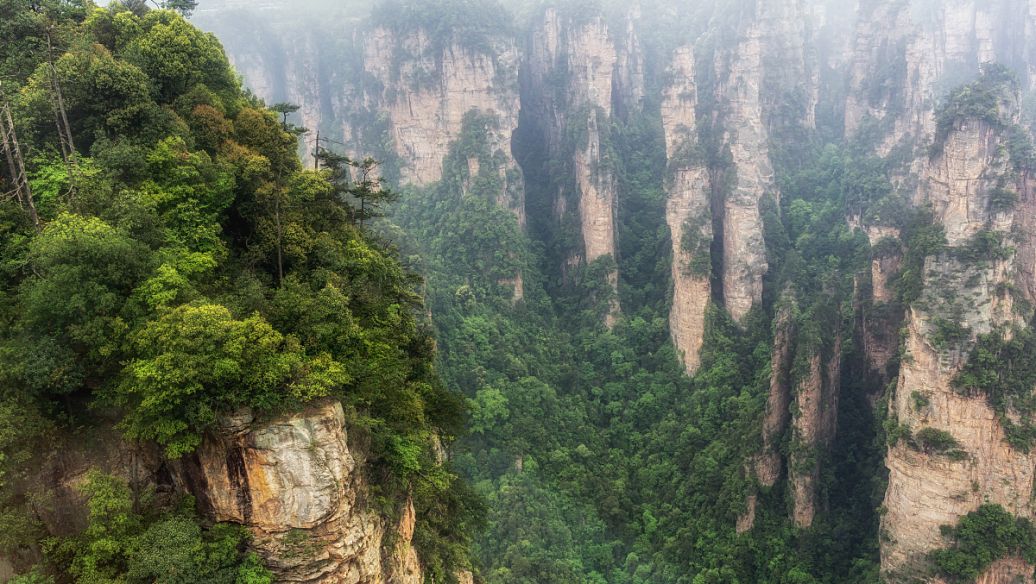
Zhangjiajie Grand Canyon lies deep within the heart of Wulingyuan, a breathtaking natural wonder carved by nature’s masterful hand. Its sheer cliffs rise like blades or axes, soaring vertically over 300 meters high, while mist and clouds swirl through the valley floor, evoking an ethereal fairyland. Suspended along these precipitous cliffs, the glass-bottomed walkway winds like a dragon plunging into the sea; stepping upon it offers dizzying views down into the roiling sea of clouds, leaving visitors awestruck.
Within the canyon, towering stone pillars stretch for kilometers, standing like colossal giants. When sunlight filters through the mist, dappled light and shadow create illusions of a celestial palace.
The core attraction, Mihun Terrace, is famed for its dramatic steepness, offering panoramic vistas of the entire canyon. Tianzi Mountain, renowned for its sword-like peaks shrouded in swirling clouds, appears from afar as if an emperor himself were surveying his realm. Along Golden Whip Creek, gentle streams murmur past, with stone peaks mirrored perfectly in the clear water, unfolding like a traditional Chinese landscape scroll. Deeper within the canyon lies Yuanjiajie Scenic Area—the very location where scenes from *Avatar* were filmed—where gravity-defying pinnacles resemble floating Hallelujah Mountains, astonishing all who behold them.
The name “Wulingyuan” originates from the legendary Peach Blossom Spring described by Tao Yuanming, a poet of the Eastern Jin Dynasty. For generations, the Tujia ethnic group has thrived here, leaving behind rich cultural heritage such as stilted houses and Xilankapu brocade weaving. Local folklore also tells the tale of the “Three Sisters Who Descended from Heaven.”