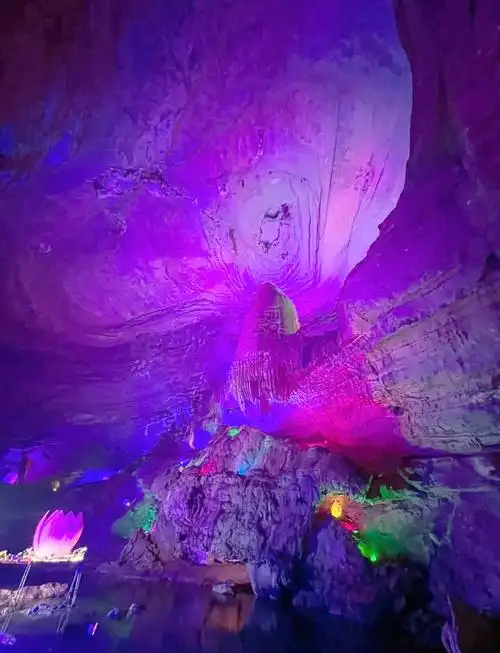
Nestled at the southern foot of Mount Lu, Longgong Cave is a rare large-scale karst cave in eastern China, hailed as the "Underground Crystal Palace." Inside, stalactites and stalagmites rise in dense, orderly formations, stone pillars soar toward the ceiling, and gentle streams murmur through the cavern. As light and shadow interplay, visitors feel as though they’ve stepped into the mythical Dragon King’s hidden palace.
The most breathtaking feature is the main chamber, aptly named the "Crystal Palace," where clusters of stalagmites over thirty meters high stand like towering jade pillars. Under carefully placed lighting, translucent stalactites shimmer with an ethereal blue glow, resembling a cascade of the Milky Way. A subterranean river flows through the cave, its gentle gurgling accompanied by misty veils; occasionally, fish dart through the water, enhancing the otherworldly ambiance.
Near the entrance, the inscription "Longgong" (Dragon Palace) remains faintly visible. Legend has it that the renowned Northern Song dynasty calligrapher and literary giant Huang Tingjian once composed a poem here—his bold, vigorous characters harmonizing perfectly with the cave’s natural wonders. The Ming dynasty geographer and traveler Xu Xiake was so awestruck upon visiting that he declared it “a paradise beyond the mortal realm” and meticulously documented its hydrological features and geological formations.
Scattered throughout the cave are eighteen remarkable sights, including "Dragon Scale Stone," "Jade Maiden’s Dressing Table," and "Immortals’ Chessboard"—each a testament to nature’s extraordinary artistry. Visitors can board a boat to glide along the underground river, gazing upward through portholes at the magnificent stalactite formations overhead, experiencing a surreal journey through time and space. More than just a geological marvel, Longgong Cave embodies over a thousand years of cultural heritage, making it a sublime destination where nature and human history intertwine.