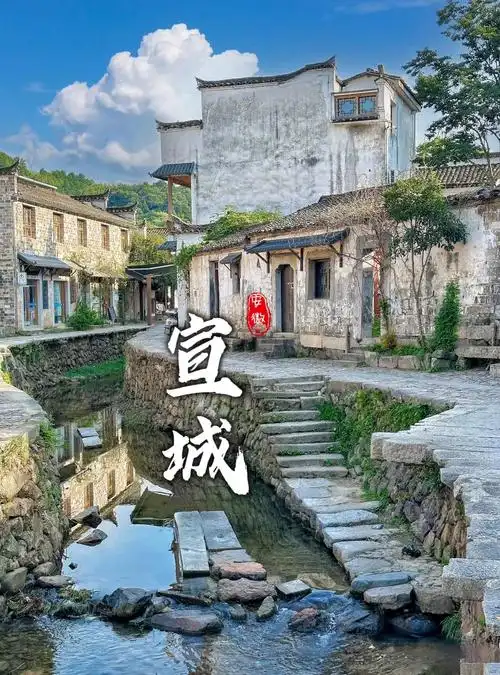
Xuanzhou Ancient City nestles against gentle hills and embraces the winding Qingyi River, its thousand-year history crystallized like amber among grey bricks and dark-tiled roofs. Strolling beneath the ancient city walls, one can still touch fragments of poetry manuscripts from the Southern Qi and Liang dynasties—traces left by the poet Xie Tiao—embedded in the rammed earth layers. Within the arched gateways, echoes of war drums once beaten by Qi Jiguang, the Ming dynasty general famed for repelling Japanese pirates, still resonate faintly.
The old streets and alleyways weave through the city like brocade; time-worn vines cascade down from the grey tiles of horse-head gables. Through the intricately carved window lattices of the Hu Clan Ancestral Hall, one can glimpse the prosperous carriages of Ming-era Huizhou merchants returning to their hometown.
At the foot of Jingting Mountain to the west, the inked lines of Tang dynasty poet Li Bai—"Gazing at each other, never weary, only Jingting Mountain and I"—remain vivid. The mountain’s ancient temple bell tolls across millennia, startling egrets into flight over the Qingyi River. Deep within the city lies the remnant of a Ming dynasty city wall, where Song dynasty pottery shards and Yuan dynasty copper coins lie buried in the rammed earth—each brick and stone whispering the weight of the name "Xuanzhou."
Every Qingming Festival, local residents still observe ancient rites, offering incense before the City God Temple to pray for favorable weather and bountiful harvests. More than just a geographic landmark, this place is a living museum of southern Anhui’s cultural DNA, where every visitor standing in the dappled shadows of aged walls can hear the heartbeat of history.