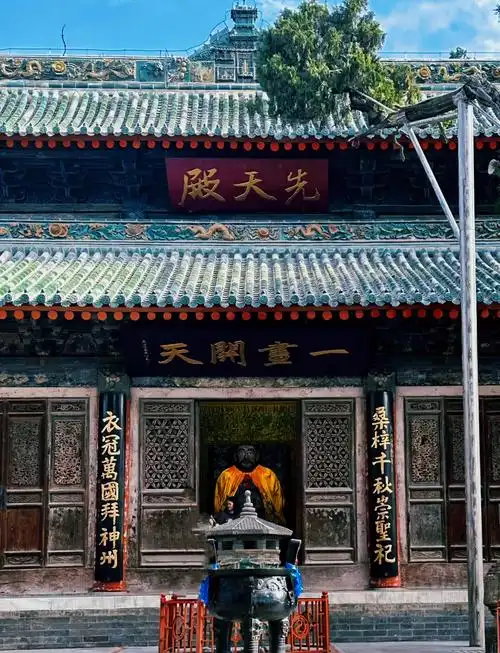
The Fuxi Temple, located in Maiji District of Tianshui, Gansu Province, is a sacred site dedicated to the worship of Fuxi—the legendary cultural ancestor of the Chinese nation. Amidst ancient cypress trees cloaked in deep green, echoes of primordial myths resonate through time, and every gray brick is etched with the coded essence of civilization. Built against the mountainside, the temple follows a solemn central-axis layout. Its Bagua (Eight Trigrams) platform base and the Nine-Ding Hall complement each other harmoniously, embodying the wisdom of the Zhouyi (I Ching) within its architectural form. Before the main hall stand six towering ancient cypresses, their gnarled branches twisting skyward; over a thousand years old, the deep grooves and weathered textures on their trunks seem to narrate tales of creation.
The core scenic area centers around the Fuxi Hall, which houses a colossal clay statue of Fuxi. His eyes, bright and penetrating, gaze benevolently upon all living beings. Surrounding reliefs depict symbols of early civilization—dragon totems, knot-tying for record-keeping, and hunting motifs—all encoded with the foundational elements of Chinese culture. Embedded in the Bagua platform is a bronze yin-yang disc inscribed with the sixty-four hexagrams of the Yijing, subtly revealing its profound mysteries. To the west, a forest of steles stands tall, including one inscribed with the “Stele of Fuxi” personally calligraphed by Dong Qichang, a renowned Ming Dynasty calligrapher. His vigorous brushwork flows with reverence for this cultural progenitor.
Revered as the foremost among the "Three Sovereigns," Fuxi is credited with foundational contributions to Chinese civilization, including the invention of writing, the development of fishing and hunting practices, and the establishment of marriage rites. Within the temple grounds, an extant stone inscription titled “Inquiry into Fuxi” records the historical anecdote of Jiang Ziya—a famed statesman of the Zhou Dynasty—performing divination here before meeting King Wen of Zhou by the Wei River. Each year during the Spring Equinox ceremony, people dressed in traditional Hanfu attire beat drums and ring bells, reenacting the ancient ritual of “observing celestial phenomena above and examining terrestrial patterns below,” thereby revitalizing these ancient cultural codes in the modern era.