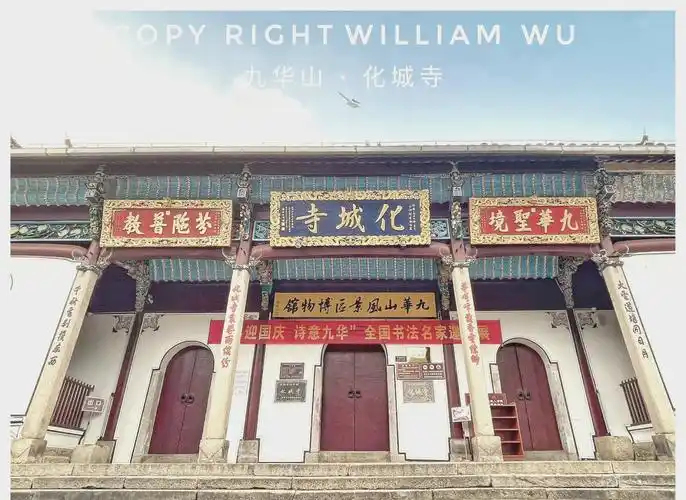
Huacheng Temple is nestled in the heart of Jiuhua Mountain Scenic Area. Originally built during the Zhenguan era of the Tang Dynasty, it serves as a significant subsidiary monastery of the sacred site dedicated to Ksitigarbha Bodhisattva. The current temple complex, a millennium-old sanctuary, blends architectural styles from the Song and Ming dynasties. Its upturned eaves and interlocking brackets echo the rhythm of time, while ancient cypresses tower skyward, their dense foliage seemingly carrying the murmurs of Buddhist chants.
Incense smoke has risen continuously here for centuries, drawing a steady stream of pilgrims. The Ksitigarbha Bodhisattva Hall stands as the most solemn structure on the grounds, housing a nine-meter-tall white marble statue of the Bodhisattva—gentle-eyed and compassionate, holding a khakkhara (monk’s staff)—evoking profound reverence in all who behold it.
The main scenic area centers around the Mahavira Hall, flanked by side chambers and a scripture library that preserves a Ming Dynasty woodblock edition of the "Sutra of Ksitigarbha Bodhisattva." The intricate carvings remain exquisite, and the faint scent of ink still lingers. In the adjacent pond for releasing captive animals, ornamental carp glide gracefully through the water. Carved boldly into the cliffside beside the pond are the characters “Hua Cheng” (Transformed City), traditionally attributed to the eminent Tang monk Fa Ren.
Among the temple’s most awe-inspiring treasures is the Pavilion of the Thousand-Armed and Thousand-Eyed Guanyin. Though its painted surfaces have faded over time, fragments of Song Dynasty murals remain visible beneath the peeling layers. Touching the weathered bricks, one can almost hear the echoes of sutra recitations spanning a thousand years.
Since the Tang Dynasty, Huacheng Temple has been a pilgrimage site for poets and scholars alike. The famed Tang poet Li Bai once spent a night here listening to the rain, later composing the lines: “The road to Jiuhua shrouded in misty clouds; distant smoke drifts beneath maple trees, crimson against forested hills.” The Ming Dynasty geographer and traveler Xu Xiake also visited, marveling at its “ethereal mountain hues, even more wondrous in the rain.”
The temple’s cultural relics museum houses precious artifacts, including a Song Dynasty bronze clepsydra (water clock) and a Yuan Dynasty blue-and-white porcelain incense burner—testaments to the temple’s rich cultural heritage spanning over a millennium. Each Mid-Autumn Festival, the monks of the temple...