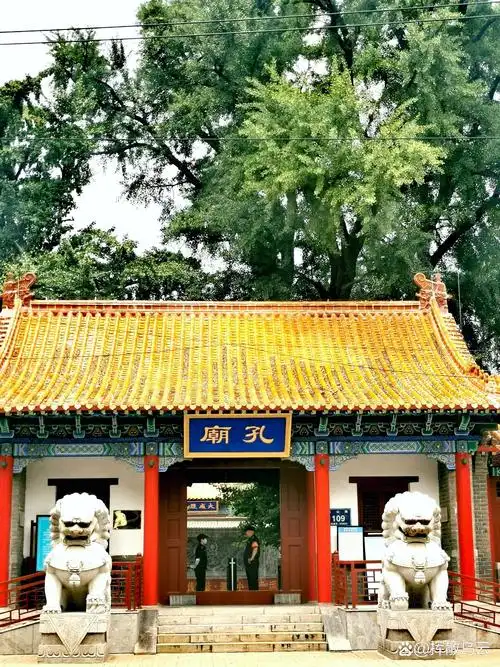
Built against a mountain backdrop and beside flowing water, the Taichung Confucius Temple replicates the imperial Beijing-style architectural complex to embody Confucian rites. Its upturned eaves and soaring ancient cypresses together create an atmosphere of solemn dignity. The nine steps leading to the main hall symbolize the "Nine Classics" of Confucianism, while the bluestone dragon-carved stairway subtly embodies the harmony between heaven and humanity. Inside the hall, twelve exquisitely carved coiled-dragon pillars stand tall, and the beams and lintels are adorned with colorful paintings depicting the "Twenty-Four Filial Exemplars," encapsulating the spirit of Confucian ethics in every detail. Flanking the Lingsheng Gate, lifelike stone lions guard the entrance, and the bold inscription "Wan Shi Shi Biao" ("Model Teacher for All Ages") above the gatepowerfully affirms the orthodox status of Confucian teachings.
Centered on the Dacheng Hall as its main axis, the core precinct features the Chongsheng Shrine in front—dedicated to Confucius’s Twelve Disciples—and the Minglun Hall behind, which displays surviving fragments of the Qing-era "Taichung County Gazetteer." Along the eastern and western corridors, rows of stelae stand side by side: among them, a tablet inscribed by Yan Fu (a modern Chinese thinker) bearing the words "Ge Wu Zhi Zhi" ("Investigation of Things and Extension of Knowledge") harmonizes beautifully with a plaque gifted by Kang Youwei (a late-Qing reformer) reading "Dao Guan Gu Jin" ("The Way Unites Past and Present"). In the ancient cypress grove, seven thousand-year-old trees stretch their gnarled, vigorous branches; faint inscriptions carved during temple repairs funded by Zeng Guofan (a prominent late-Qing statesman) can still be discerned in the cracks of their bark.
Originally constructed in 1931 to commemorate Confucius’s birthday, this temple uniquely blends southern Fujian red-brick architecture with northern official-style design, making it Taiwan’s only Confucian temple built according to the specifications of Beijing’s Confucius Temple. All ritual vessels inside replicate those housed in the Palace Museum, and ceremonial robes follow patterns described in the "Book of Rites." During the annual Confucius memorial ceremony, the resonant harmony of the "Eight Tones" evokes the enduring Confucian ideal of "gentle moral influence like spring rain," nurturing the shared cultural roots across the Taiwan Strait.