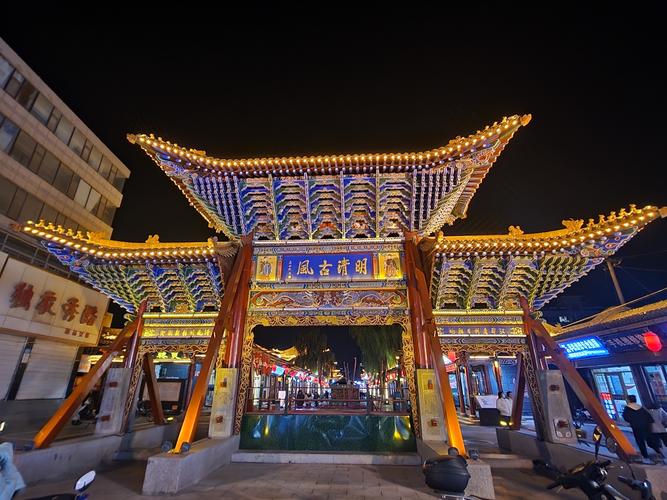
Lanzhou’s most vibrant commercial street, Zhangye Road Pedestrian Street, blends the city’s century-old mercantile heritage with the lively spirit of everyday life, seamlessly merging old Lanzhou’s neighborhood charm with contemporary urban flair. Cobblestone-paved lanes are lined with time-honored establishments like “Zhangye Road Lao Ma Jia” and “Zhangye Road Beef Noodles,” whose aromas have wafted through the air for decades, standing side by side with flagship stores of trendy brands and designer studios—an intriguing dialogue between tradition and modernity. At corner cafés with floor-to-ceiling windows, the ceaseless flow of the Yellow River provides a backdrop; morning light carries echoes of camel bells mingling with urban bustle, while evening neon lights dance alongside wisps of cooking smoke, sketching out Lanzhou’s unique aesthetic of daily life.
At the heart of the pedestrian zone stand three cultural landmarks: the Yellow River Iron Bridge, built in 1907, which has witnessed Lanzhou’s transformation from “Golden City” to modern metropolis; the “First Drift on the Yellow River” experience zone beside Zhongshan Bridge, offering tangible encounters with Yellow River culture; and Bai Ta Shan Park, whose elevated vantage point unfolds the entire street like a living scroll. More than just a shopper’s paradise, this area serves as a dynamic museum of Lanzhou’s urban memory—every brick wall etched with the commercial DNA of a historic Silk Road hub.
As the birthplace of Lanzhou’s commercial civilization, Zhangye Road once served as the trading center for Gansu-Qinghai merchant guilds, nurturing the distinctive “Lanzhou Prefecture” merchant culture. During the Republican era, patriotic industrialist Fan Xudong championed national industry here; the former site of his Jiuda Salt Company still lies hidden deep within the alleyways. This street embodies Lanzhou’s evolution from an ancient Silk Road stronghold into a modern commercial capital—a microcosm of the city’s soul and one of Northwest China’s most vivid cultural fragments.