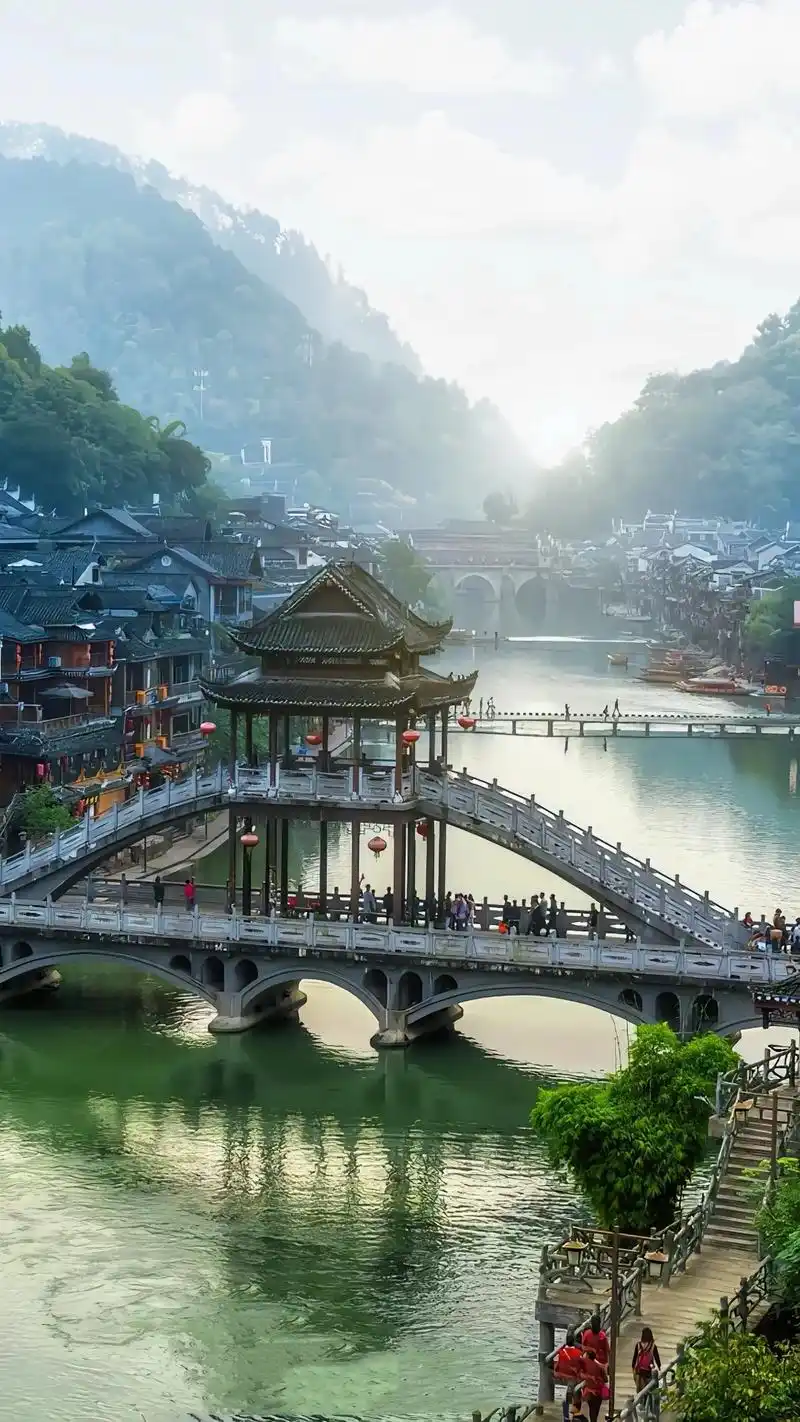
Built against the mountains and beside the river, Fenghuang Ancient Town is embraced by the Tuo River, which winds like a jade-green ribbon through the Xiangxi hills. Cobblestone paths meander among stilted houses, while the millennium-old city walls and Ming-Qing architectural complexes reflect each other in harmonious splendor, preserving the ancient essence of Xiangxi like amber frozen in time.
The Rainbow Bridge arches gracefully over the Tuo River; at dawn, wisps of mist swirl around it, unfolding a scene as poetic as an ink-wash painting. Wanming Pagoda pierces the clouds with its spire, and as twilight falls, lanterns illuminate the eaves of stilted houses, their glow dancing with reflections on the Tuo River to create a shimmering tapestry of light.
The weathered rammed-earth walls of the East Gate Tower silently witness the poetic "Border Town" immortalized by Shen Congwen, the modern Chinese writer. Meanwhile, ferry boats still depart from the West Gate Wharf, their gentle clinking of Miao silver ornaments carried by young Miao women echoing tales of millennia-old migrations along the river.
Founded during the Eastern Han Dynasty over 2,000 years ago, this ancient town once served as the cultural center of the Tusi chieftain system in western Hunan. Generations of Miao and Tujia ancestors thrived here, nurturing unique stilt-house construction techniques and exquisite Miao silver craftsmanship. Drifting along the Tuo River, one may glimpse porters shouldering bamboo baskets against the mountain backdrop, while deep within alleyways, Miao folk songs and the rhythmic beats of Nuo opera drift through the air—each gray brick etching the legend of “China’s last ancient town.”
Shen Congwen’s literary masterpiece *Border Town*, inspired by this very region, has forever enshrined Fenghuang as a timeless landmark in Chinese literary history. Even today, the stilted houses lining the Tuo River safeguard the cultural code of “Shen Congwen’s Border Town.”