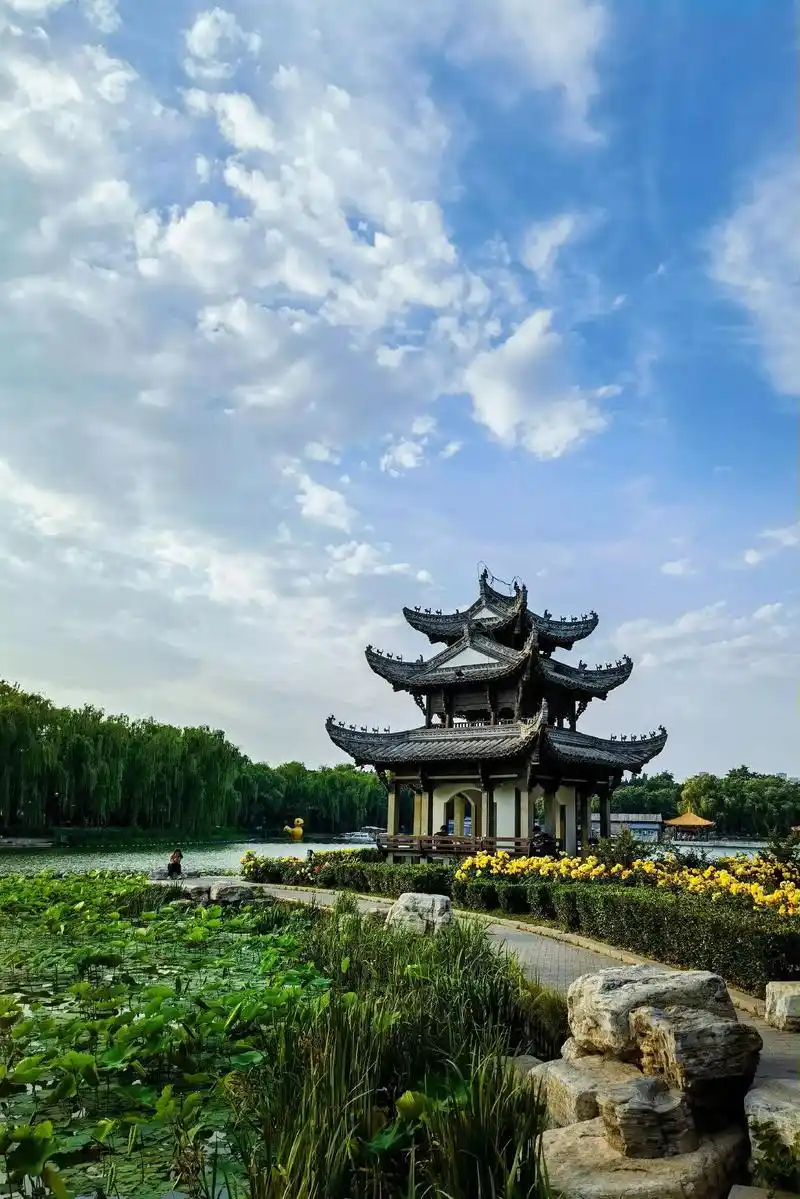
Located in Beijing’s Xicheng District near the Cijie Bridge, this natural garden integrates lake and mountain scenery with humanistic charm. At its core is “Tàràn Tíng,” a renowned pavilion from the Qing Dynasty, beautifully contrasting with its curved roofs and intricate carvings. It was a gathering place for scholars and poets. Along the Long Ti (Long Riverbank), ancient ginkgo trees stand tall, and stone carvings are abundant, with “Guānlán Tíng” (Viewing Waves Pavilion) and “Fēnglín Gé” (Maple Forest Pavilion) being particularly captivating. The island’s “Lájīng Yǔ Xuán” (Come Today Rain Pavilion) is the remains of a Qing Dynasty library, with inscriptions by scholars like “Tàràn,” originating from Yuan Dynasty poet Bai Pu’s “Heaven Net Sand – Autumn.” “Liú Làng Wén Yīng” (Willow Listen Birds Sing) and “Hé Fēng Sòng Xiāng” (Lotus Wind Send Fragrance) offer a blend of natural beauty and poetic imagery. Built in the Qing Dynasty during Emperor Kangxi’s 32nd year, the park’s name comes from the Qing Dynasty poet Nalan Shen De. Jin Xiao Lan, a renowned Qing Dynasty literary scholar, also studied here, and Yuan Mei frequently visited to compose poetry. The preserved sites like “Huàn Bǐ Zhuān” (Wash Brush Spring) and “Shuǐ Yuè Ān” (Water Moon Hermitage) witness the pursuit of the “Tàràn” state of mind by scholars and poets. Walking through the park, one feels like traveling through time, hearing the echoes of ancient poetry, and experiencing the quiet elegance of the fusion of nature and humanity.