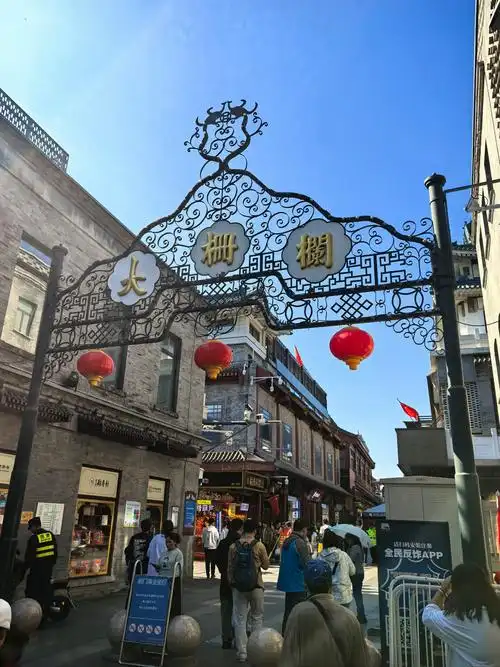
The Da Jiao Lan Commercial Street, Beijing’s most authentic and vibrant century-old commercial landmark, winds through a maze of blue-brick and gray-tiled lanes, brimming with the legends of old Beijing’s everyday life. It was the birthplace of the “fence market” during the Ming and Qing dynasties, and today it retains the texture of a traditional commercial street, as if frozen in a shimmering, glass-like world. Above the intricately carved lintel of the Ru Lao Xiang Silk and Cloth Shop, the golden characters “Ru Lao Xiang” have weathered a century of storms, witnessing the rise and fall of Chinese national commerce. Within, the craftsman still adhering to ancient methods weaves the non-heritage code of “Chinese cloth shoes,” stitch by stitch.
A stroll down Wangfujing Street (formerly known as Front Street), the imposing silhouette of the Zheng Yang Men (Arrow Tower) reflects with the surrounding traditional buildings, while the aroma of authentic Beijing fried peanut sauce (Dui Yi Chu) hides behind the crimson-lacquered gates. Inside the Folk Customs Museum, the sandalwood scent of Qing Dynasty cabinets blends with the azure blue of Jingtai enamel, and artisans are meticulously crafting auspicious scenes of “Eight Immortals Crossing the Sea” using traditional techniques. This street is not just a shopping paradise, but a living museum of old Beijing’s “Qingwei Culture.”
As the “Golden Street” where merchants gathered at the end of the Qing Dynasty, Da Jiao Lan witnessed the rise and fall of Prince Yi Kuang’s (a Qing Dynasty political figure) residence, and was the route taken by Li Hongzhang (a key minister of the late Qing Dynasty) to negotiate with the imperial court. Today, this street, carrying the legacy of the “Three Great Shops” (Gou Bu Li, Pien Yi Fang, and Dui Yi Chu), continues the legends of established brands through protective development, with each blue brick telling a tale of “Qinhua Baiye” (Beijing’s industries) – its vicissitudes.