Temple of Heaven Park

⭐ 5.00

No. 7 Tian Tan Nei Dong Li, Dongcheng District, Beijing, Temple of Heaven Park Management Office, Temple of Heaven Park Scenic Area

Temple of Heaven Park
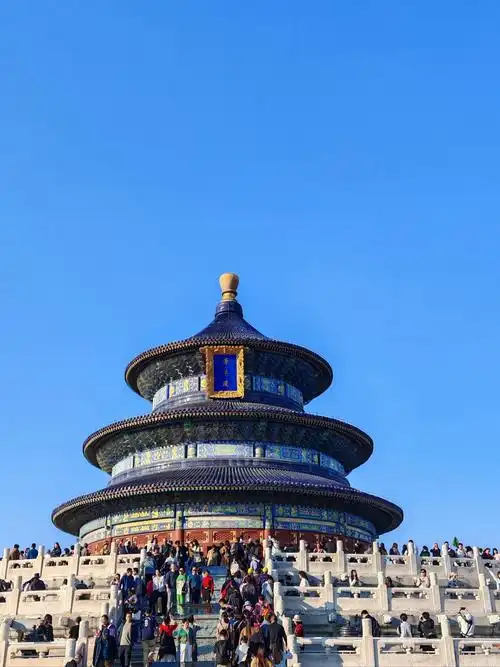
**Historical Evolution** The Temple of Heaven was first built in the 18th year of the Yongle reign of the Ming Dynasty (1420), serving as the exclusive venue for Ming and Qing emperors to offer sacrifices to heaven and pray for good harvests. It hosted two state-level ceremonies: "winter solstice sacrifices to heaven" and "early spring prayers for grain." The entire architectural complex strictly follows the cosmological concept of "round heaven and square earth" — the Circular Mound Altar symbolizes the round heaven, while the Hall of Prayer for Good Harvests to the north signifies prayers for a bountiful harvest, forming the ceremonial pinnacle of the southern section of Beijing's central axis and standing as a physical testament to ancient Chinese sacrificial culture. **Architectural Beauty** The Hall of Prayer for Good Harvests features a circular pyramidal roof with three tiers of eaves, covered in blue glazed tiles symbolizing the sky. The 28 nanmu wooden columns inside correspond respectively to the four seasons, the twelve months, and the twenty-eight lunar mansions, with numbers and ritual conventions in perfect alignment. The Circular Mound Altar is a three-tiered open-air white marble platform, where all steps and stone slabs are multiples of "9" — the supreme yang number. The "Heart of Heaven Stone" at the center is the core of the sacrificial site; standing upon it produces a focusing and amplifying effect on sound. **Acoustic Wonders** The circular wall surrounding the Imperial Vault of Heaven is the famous "Echo Wall," which uses the principle of curved-surface acoustics to transmit sound across the barrier — whispers spoken softly against the wall can be heard clearly on the opposite side. The "Triple Sound Stone" at the center of the courtyard produces multiple echoes when struck by clapping. This acoustic design, four centuries old, still amazes visitors today and stands as a quintessential example of the fusion of ancient technology and art. The quieter the surroundings, the more wondrous the experience. **Visitor Information** The combo ticket (34 yuan in peak season) is a must-purchase, covering the three core sites: the Hall of Prayer for Good Harvests, the Echo Wall, and the Circular Mound Altar. The basic admission ticket (15 yuan) does not include entry to these. Core buildings are closed for maintenance on Mondays; it is recommended to make a real-name reservation 1–7 days in advance via the "Changyou Park" or "Temple of Heaven" WeChat official accounts. The park is open from 6:00 to 22:00, with core buildings open from 8:00 to 17:30 (extended to 18:00 in peak season). Foreign visitors may use the passport lane, and electronic audio guides in 17 languages are available for rent within the park. **Tour Route** The recommended route is to enter from the East Gate and exit from the South Gate, following a one-way journey along the central axis without backtracking: Seventy-Two Long Corridors → Hall of Prayer for Good Harvests → Danbi Bridge → Imperial Vault of Heaven (Echo Wall) → Circular Mound Altar → South Gate, taking approximately 2.5–3 hours. Metro Line 5, "Temple of Heaven East Gate Station," Exit A, provides direct access; parking by car is difficult. From 8–9 a.m. or after 4 p.m., crowds are lighter and the light is softer, making for excellent photo opportunities. **Helpful Tips** Summer brings high temperatures and frequent rain, so sun protection and drinking water are essential; dining prices within the park are relatively high, so bringing your own snacks is recommended. Ancient trees tower throughout, with the famous Nine-Dragon Cypress (over 600 years old) being especially renowned. The park is ideal for family leisure or photography strolls. Do not trust scalpers selling guide services at the gate; visitors with ample time may also visit the Fasting Palace on the western side to experience the quiet tranquility of the place where emperors observed their fasts.

Traveler reviews

As a sacred site where emperors of the Ming and Qing dynasties offered sacrifices to heaven and prayed for good harvests, Beijing's Temple of Heaven reaches the pinnacle of architectural, aesthetic, and cultural achievement. If I had to evaluate it across several dimensions: ### 1. Architectural Aesthetics: Minimalist yet Monumental The Temple of Heaven breaks from the traditional palace convention of "more is more," instead masterfully employing **expansive negative space and striking contrasts**. * **The Ultimate Fusion of Circle and Square**: The circular pointed roofs of the Hall of Prayer for Good Harvests and the Imperial Vault of Heaven harmonize perfectly with the square walls and broad bases, giving tangible form to the ancient Chinese cosmology of "round heaven, square earth." * **A Symphony of Color**: Unlike the Forbidden City's vast expanses of "red walls and yellow tiles," the Temple of Heaven's core structures feature a distinctive **deep blue glazed tile**, symbolizing the boundless sky. When the azure rooftops mingle with the emerald ancient c...
⭐ 4 · Jamie Cole Expand
The Temple of Heaven is the sacred site where Ming and Qing emperors offered sacrifices to heaven and prayed for good harvests — honestly, it's the pinnacle of classical Chinese architectural aesthetics. The whole park is filled with towering ancient trees, with lush pines and cypresses surrounding you, and the blue-tiled roofs paired with red walls create such an atmospheric vibe. The Hall of Prayer for Good Harvests is absolutely magnificent and beautifully crafted, while the Circular Mound Altar has a perfectly symmetrical l...
⭐ 5 · Sage Williams Expand