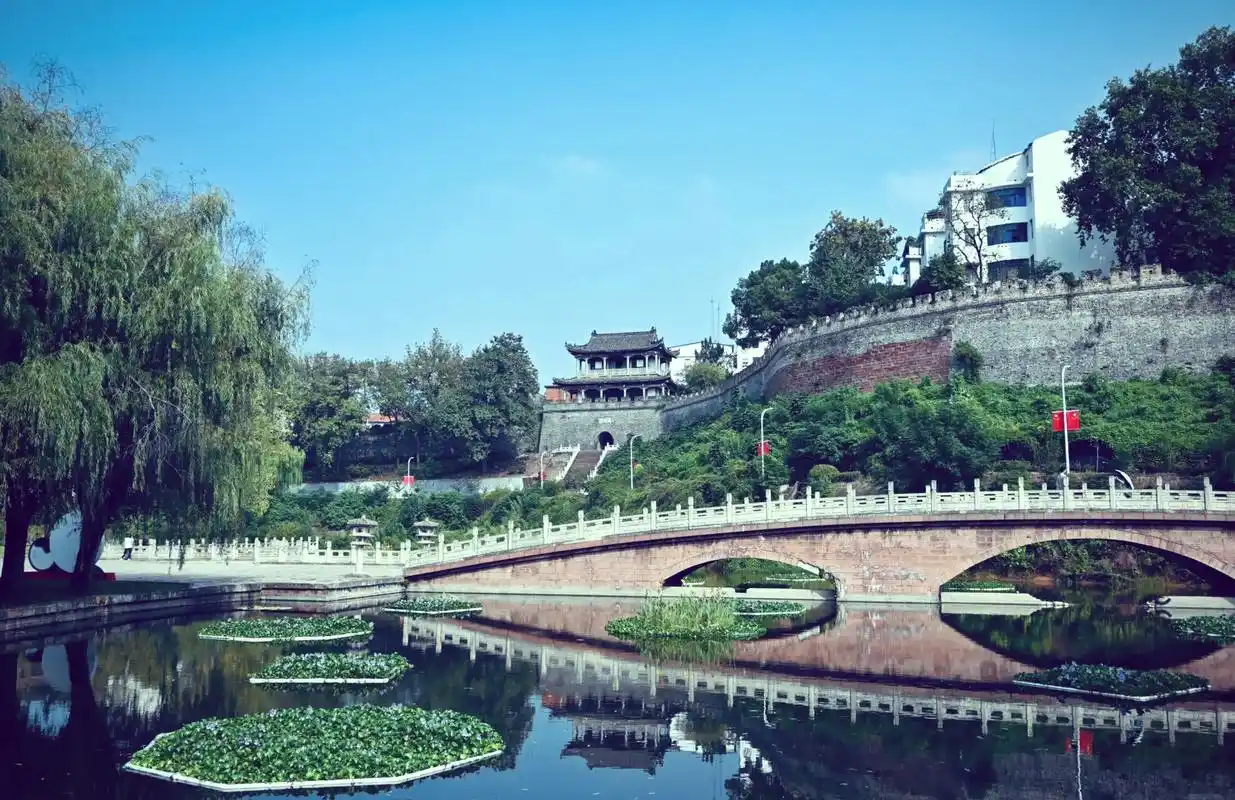
The ancient Huangzhou district, located in Huanggang City, Hubei Province, is one of the best-preserved clusters of ancient architecture from the Ming and Qing dynasties. Traditional residences with grey bricks and tiled roofs are arranged in harmonious disorder, their gracefully upturned eaves and interlocking brackets radiating a mellow luster shaped by time. The streets and alleys still retain the everyday atmosphere of Ming-Qing urban life, creating a living museum that feels like stepping through time.
At the heart of the scenic area lies Dongpo Red Cliff, a steep cliff overlooking the Yangtze River. Here, the Northern Song literary giant Su Shi once sailed and composed poetry. The cliff face is adorned with numerous cliffside inscriptions, including the four characters “Dongpo Red Cliff” inscribed by Wen Tianxiang, the famed Southern Song general who resisted the Yuan dynasty—his calligraphy bold and powerful. Among the Song-era stone carvings is an inscription by Huang Tingjian, the Northern Song calligrapher, which complements Su Shi’s renowned “Nian Nu Jiao: Reminiscence of the Red Cliff” in poetic dialogue. Within the old lanes and courtyards, the plaque reading “Huangzhou Red Cliff” can be glimpsed faintly behind intricately carved wooden windows. Ming-Qing commercial buildings and ancestral halls nestle skillfully into the hillside, embodying the feng shui philosophy of harmony between humanity and nature.
During his exile to Huangzhou, Su Shi pioneered the “free-spirited” style of calligraphy and penned immortal masterpieces such as “Nian Nu Jiao: Reminiscence of the Red Cliff,” transforming Huangzhou into a spiritual haven for literati. Today, the ancient district preserves over 20 Ming-Qing buildings, whose exquisite brick and wood carvings represent a living fossil of architectural art in eastern Hubei. Strolling along its cobblestone paths, one hears echoes of history beneath each step—every brick and tile whispering the enduring legacy of a thousand-year cultural lineage.