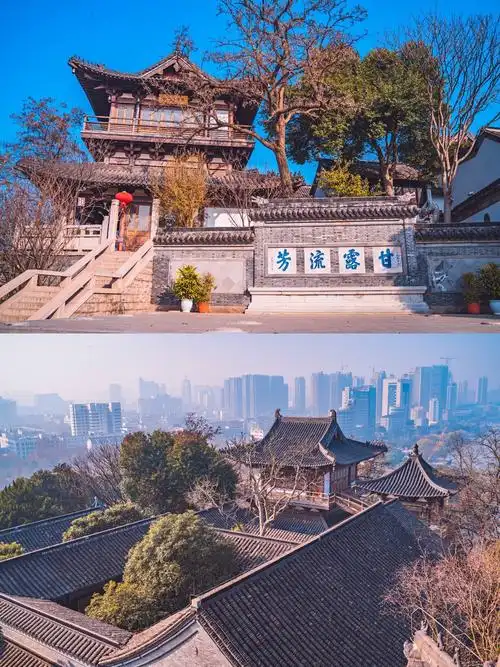
Perched majestically south of Jinshan in Zhenjiang, Beigu Mountain rises with sheer cliffs soaring into the sky, swept by powerful winds from the Yangtze River. Since ancient times, it has been a strategic stronghold fiercely contested by military commanders. Resembling a colossal dragon coiled upon the earth, its summit offers breathtaking views of the mighty Yangtze surging below. Scattered throughout the mountain are numerous historical relics, seamlessly blending the mists of history with natural grandeur.
Halfway up the slope stands Ganlu Temple, originally built during the Eastern Wu period. Among its gracefully upturned eaves and intricate brackets lie the remains of Sun Ce’s (a renowned military leader of the late Eastern Han dynasty) command platform, while faint hoof marks from his warhorses can still be discerned on the weathered stone slabs. The cliffside stone carvings preserve inscriptions and poems by literati through the ages, including the bold characters “Beigu Mountain” inscribed by Mi Fu, the celebrated calligrapher of the Northern Song dynasty. By the riverside Pavilion Lingjiang, the Southern Song poet Lu You once penned the immortal lines, “Evening river sounds rush urgently; mountain shadows meet the setting sun,” allowing later generations to still feel the fervent passion of a thousand years past.
At the mountain’s foot, the symbolic tomb of Gan Ning (a famed general of Eastern Wu) faces Sun Ce’s burial mound across the river, while the ruins of the “Eastern Wu Imperial Palace” on Jiangxin Island whisper tales of the Six Dynasties’ misty past. As twilight descends, the river wind carries echoes of Sun Quan’s (founder of Eastern Wu) iron-willed legacy, harmonizing with Su Shi’s (Northern Song literary giant) poetic vision—“Vast the river, low the clouds; a lone wild goose cries in the west wind”—leaving visitors spellbound and reluctant to depart. This mountain is both a beacon of ancient battles and a spiritual symbol cherished by poets and scholars through the ages.