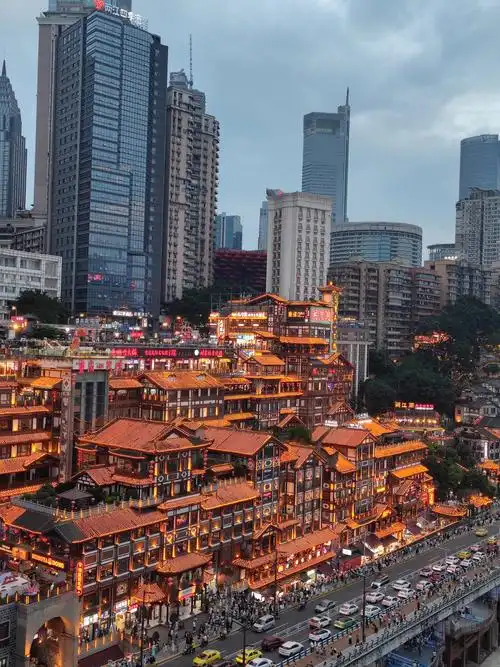
Hongya Cave is Chongqing’s most iconic nighttime landmark, renowned for its fantastical, multi-tiered architecture. Built into the mountainside, its staggered stilted houses rise layer upon layer like a celestial palace suspended in midair. When illuminated at night, the entire complex glows brilliantly, as if stars have fallen to earth. This site not only inspired the animated film *Spirited Away* but also embodies over a thousand years of Chongqing’s vibrant urban life and cultural heritage. From the observation deck, visitors can enjoy a panoramic view of the dazzling night scene where the Jialing and Yangtze Rivers converge; the shimmering reflections of the buildings on the water create an ethereal blend of reality and dream.
The core area includes the Hongya Cave architectural complex, the filming location that inspired *Spirited Away*, the Air-Raid Shelter Museum, and the viewing platform for the Yangtze River Cableway. Constructed primarily from grayish-white sandstone, the buildings feature upturned eaves and intricately carved window lattices that reflect Ming- and Qing-era architectural aesthetics. Inside, a labyrinth of alleys interweaves traditional teahouses, artisan workshops, and local snack stalls, forming a unique tapestry of everyday urban culture. The Air-Raid Shelter Museum displays relics from wartime air-raid shelters, bearing witness to the city’s resilience in protecting its people during the Second Sino-Japanese War.
Hongya Cave’s history dates back to the Song Dynasty. During the Ming Dynasty, it served as the seat of Chongqing’s prefectural government. The famed Tang Dynasty poet Li Bai once visited and composed verses here, describing the magnificent scene as “two rivers embracing the city walls, with a thousand peaks layered in emerald hues.” According to the *Gazetteer of Chongqing Prefecture* from the Qing Dynasty, it was hailed as “the premier cave of the mountain city,” a title still fitting today, as the site continues to showcase its remarkable “caves within caves, buildings beyond buildings” layout. More than just a meeting point of nature and culture, Hongya Cave stands as a testament to Chongqing people’s ingenuity in building a “three-dimensional city”—every brick and stone etched with the legends of this mountain metropolis.