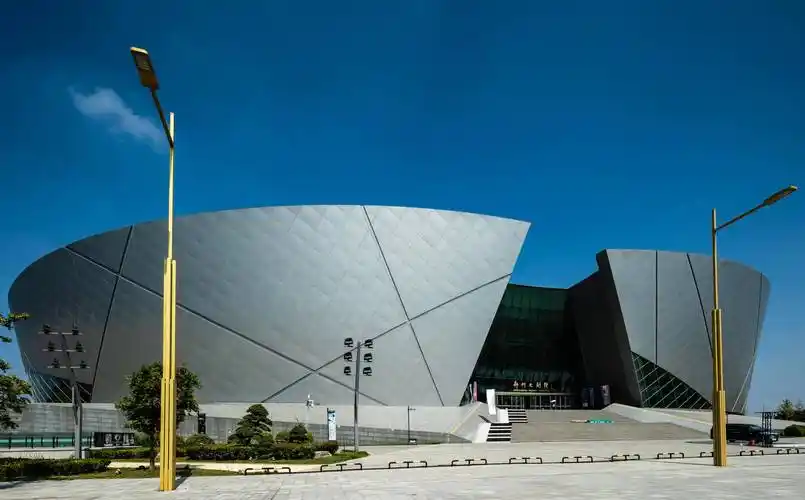
Zhengzhou Grand Theatre stands at the heart of the city's cultural corridor, where its fluid architectural aesthetics merge with symbols of Central Plains civilization, orchestrating a symphony between modern art and historical heritage. Its mirrored façade reflects the city’s ever-changing light and shadow, while inside, world-class acoustics faithfully convey both the rich vocal tones of Yu Opera and the grandeur of symphonic music, making it a luminous jewel of art in the Central Plains.
The theatre comprises three core areas: the main stage, equipped with holographic projection and mechanical lift systems, has hosted innovative performances of the Yu Opera classic *Chaoyang Gou*; the black box theatre, constructed with traditional mortise-and-tenon joinery to replicate ancient architectural forms, regularly stages experimental drama; and the art gallery displays Yu Opera artifacts and manuscripts by renowned artists, offering an immersive journey through a millennium of Central Plains theatrical evolution. During festivals, the building’s exterior transforms into a massive LED screen, dynamically re-creating the bustling urban life depicted in the *Along the River During the Qingming Festival* scroll.
As a cultural landmark of Zhengzhou, the theatre carries profound historical memory. Its location resonates with the cultural legacy of the Daxiangguo Temple site from the Northern Song dynasty’s Bianjing capital, and its architectural design draws inspiration from the *Yingzao Fashi* (Treatise on Architectural Methods). It was here that Yu Opera master Fan Cuiting—a pioneering reformer of the genre—advanced innovations in the Xiangfu tune, and where the heroic spirit of Northern Song literary giant Su Shi’s famed verse “The Great River Flows Eastward” still echoes beneath the theatre’s starry dome. More than just a temple of art, it is a spiritual homeland where the flame of Central Plains civilization continues to burn brightly.