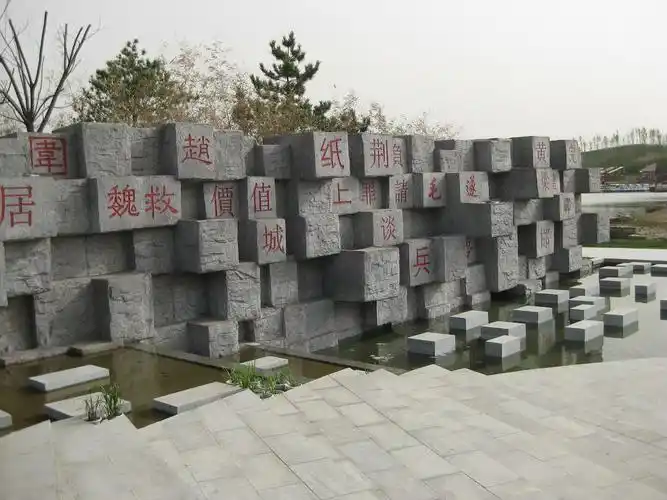
The Handan Idiom & Allusion Garden, rooted in millennia of idiom culture, seamlessly blends historical narratives with contemporary art, offering an immersive cultural space to explore the treasures of Chinese language. Through sculptures, landscaped gardens, and multimedia interactive installations, the garden brings to life iconic stories such as “Learning to Walk in Handan,” “Bearing a Rod to Apologize,” and “Harmony Between General and Chancellor,” revealing the historical context and humanistic spirit behind these idioms.
At the heart of the garden lies the “Idiom Corridor,” set against a natural backdrop of mountains and water. Here, sculptural ensembles vividly depict tales like “Adopting Nomadic Dress and Cavalry Tactics” and “Besieging Wei to Rescue Zhao,” powerfully evoking the reformist spirit of King Wuling of Zhao [ruler of the Warring States–era Zhao state]. The interactive installation “Bearing a Rod to Apologize” invites visitors to step into the role of General Lian Po [renowned Zhao general of the Warring States period], personally experiencing his humble gesture of atonement. Elsewhere, the abstract sculpture group “Learning to Walk in Handan” poignantly captures the bewilderment of a young man from Shouling in Yan, symbolizing that cultural inheritance must be grounded in one’s own roots.
As the birthplace of Zhao culture, Handan gave rise to 216 idioms and their associated stories. Through meticulously recreated scenes and artistic interpretation, the garden allows the wisdom of Lin Xiangru [Zhao minister during the Warring States period] in “Harmony Between General and Chancellor” and the courage embodied in “Returning the Jade Intact to Zhao” to transcend time and resonate deeply with visitors. Every vista becomes a dialogue between history and culture, transforming idioms from mere words on a page into tangible, perceptible strands of cultural DNA. More than just a museum of idioms, this garden serves as a decoder of the spiritual code of Chinese civilization.