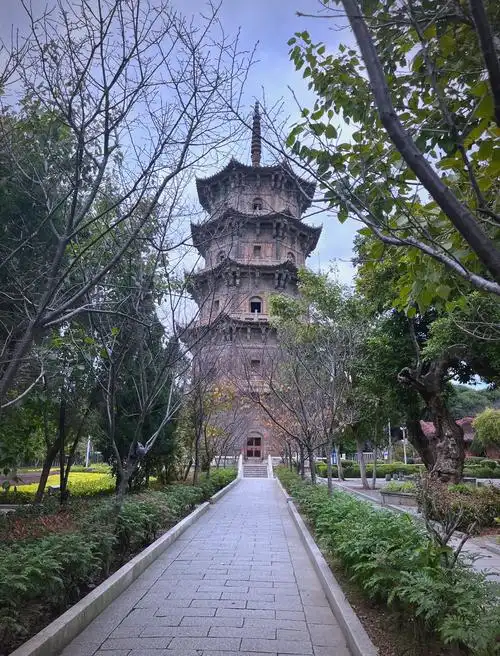
Xingtai Kaiyuan Temple was first built in the 23rd year of the Kaiyuan era of the Tang Dynasty (735 CE). Having withstood a millennium of wind and rain, it still stands majestically today as the best-preserved Tang Dynasty Buddhist temple complex in northern China. The most striking structure within the temple is the Dabei Pavilion, which houses a magnificent 25-meter-tall statue of the Thousand-Armed and Thousand-Eyed Guanyin. The walls are exquisitely carved with lotus motifs; each of the thousand hands holds a ritual implement, and each of the thousand eyes gazes compassionately upon all beings—a breathtaking masterpiece of craftsmanship.
At dawn and dusk, the resonant sounds of the temple bell and drum echo through the air. The ancient temple’s upturned eaves and glazed roof tiles shimmer under the sunlight, radiating a brilliance accumulated over a thousand years. These harmonize beautifully with the Tang-era stone lions standing before the main gate, together evoking the grandeur of the High Tang period.
Walking along the central axis, one passes through five successive halls. Over thirty stone steles remain on-site, including a Song Dynasty inscription titled “Record of the Renovation of Kaiyuan Temple,” which notes that the renowned Northern Song statesman Fan Zhongyan once oversaw restoration work here. In the west courtyard, the Sutra Repository houses a Ming Dynasty woodblock edition of the Tripitaka—its carvings delicate and the scent of ink still faintly lingering. Ancient cypress trees stand verdant, steles rise in solemn rows, and above the mountain gate still hangs the plaque inscribed with “Ancient Kaiyuan Temple,” calligraphed by the Qing Dynasty master Yibing Shou.
As a vital vessel of Buddhist culture, Kaiyuan Temple has witnessed over a thousand years of Buddhist heritage in the Xingtai region. The eminent Tang monk Jianzhen once resided here for three years, leaving behind a fragmentary manuscript of the *Great Tang Records on the Western Regions*. Moreover, the temple’s famed “Zhaozhou Tea” embodies the spirit of Chan (Zen) Buddhism—amidst the rising steam of the tea, one can almost hear the monks’ chanting from centuries past. This ancient temple, enduring through millennia, is not only a testament to history but also a sanctuary for the soul.