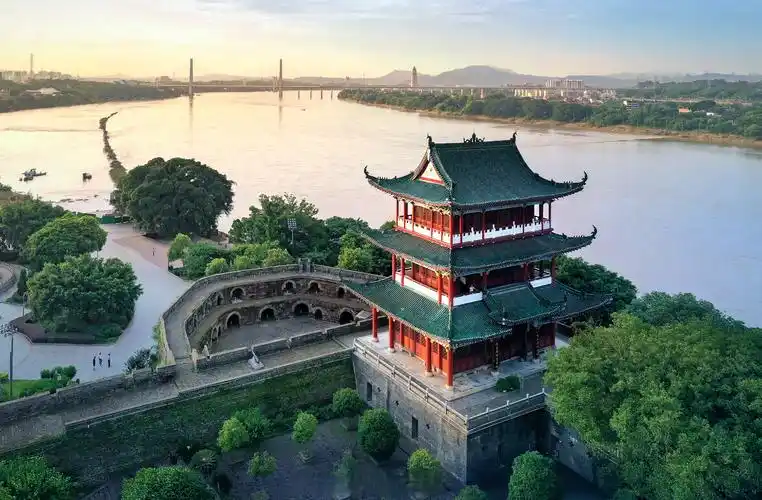
Bajing Pavilion, originally built during the Tang Dynasty and reconstructed in the Song Dynasty as a multi-storied pavilion, is one of the best-preserved Song-era historical sites in southern Jiangxi. From its elevated vantage point, visitors can overlook the magnificent confluence of the Zhang River and the Gong River, with panoramic views in all directions—hence its name “Bajing” (Eight Views). The pavilion’s architecture is exquisitely crafted, featuring upturned eaves and intricately carved beams adorned with colorful paintings. The inscribed plaque bearing the name “Bajing” serves as the crowning touch, symbolizing the essence of Ganzhou’s famed “Eight Scenic Views.”
At the heart of the scenic area stands Bajing Hall, approached by winding stone steps flanked by ancient, verdant cypress trees that invite quiet contemplation. Surrounding the pavilion are other historic relics, including Yugutai Pavilion, an iron pagoda, and an ancient well. The iron pagoda, a surviving artifact from the Song Dynasty, bears inscriptions chronicling Ganzhou’s history of water management. Legend attributes the ancient well to Han Yu, a renowned Tang Dynasty literary figure, who supposedly dug it during his exile to southern China; its clear, sweet water still flows today. From the pavilion’s summit, the Zhang River appears like a silken ribbon, while the mist-shrouded Gong River blends into the horizon, with the city’s towers and rooftops emerging and receding amid clouds and rosy dawn—creating a scene of profound serenity and delight.
Since ancient times, Bajing Pavilion has been a cherished site for poets and scholars. During the Northern Song Dynasty, the great literary master Su Shi composed here the famous lines: “Beneath Yugutai flows the limpid river—how many tears of travelers does it carry?” expressing deep sentiments for his homeland and nation. In the Southern Song Dynasty, the patriotic general Wen Tianxiang also stood at this railing, gazing into the distance and leaving behind his immortal verse: “At Huangkong Shoal, I speak of fear and dread.” Over centuries, countless inscribed poems and steles have accumulated before the pavilion, transforming its natural scenery into a vessel of cultural spirit. Thus, Bajing Pavilion has become a symbol of Ganzhou’s cultural identity. Standing here, one feels as if transported through a thousand years, sharing with ancient sages the grandeur of rivers and mountains and experiencing the unbroken continuity of Chinese civilization.