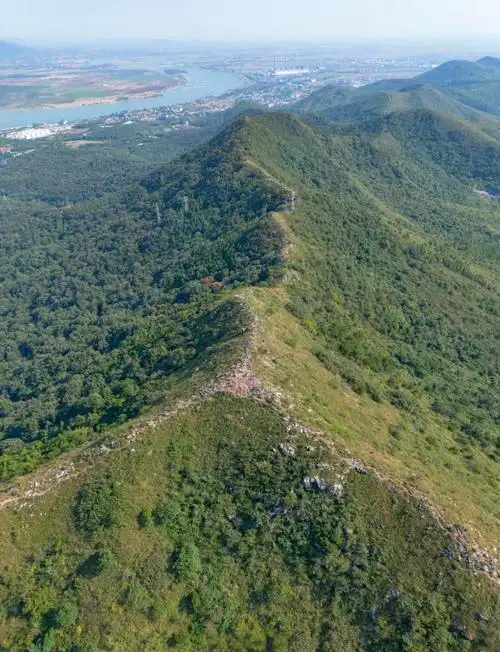
Xiayang, a natural green lung on the Han River, with an altitude of 240 meters, stands proudly on the riverbank. Climbing to the Xiayang Head Pavilion, the city walls of Xiangyang spread out like a chessboard, the Han River flowing eastward like a jade belt, and the spiritual energy of the mountains and rivers is fully embraced. The mountain is covered with cliff carvings, and the millennium cultural veins are faintly visible between the moss, with the Yang Gong Stele being the most prominent. The words "Xiangyang Xian" are powerful and vigorous, telling the story of the Western Jin general Yang Hu's construction of the city. Inside the Hall of Ancient Sages, the inscriptions and carvings of generations of literati and scholars are scattered, Du Fu's "Yang Gong's stele is still there, reading it makes my cloak wet with tears" of sadness, and Mencius's "People change, come and go, become ancient and modern" of insight and wisdom converge here. Mi Fu, a Song Dynasty calligrapher and painter, once painted and wrote here, and Lyu Yu wrote his famous poem "Xiayang Mountain outside the clouds, Han River in the mirror" here. At the waist of the mountain, the Wangjiang Tower can see the Han River flowing far away, and close to the mountain stream waterfalls, in spring, azaleas are like fire, and in autumn, the forests are dyed red, and there are different scenery in all four seasons. This mountain, which integrates natural wonders and human cultural heritage, is both the natural barrier of Xiangyang and a living carrier of the Chinese cultural vein. When looking far away, you might hear the sound of books from a thousand years ago echoing in the wind, and see the footprints of the sages of past generations extending on the stone steps, allowing modern people to touch the temperature of history between mountains and rivers.