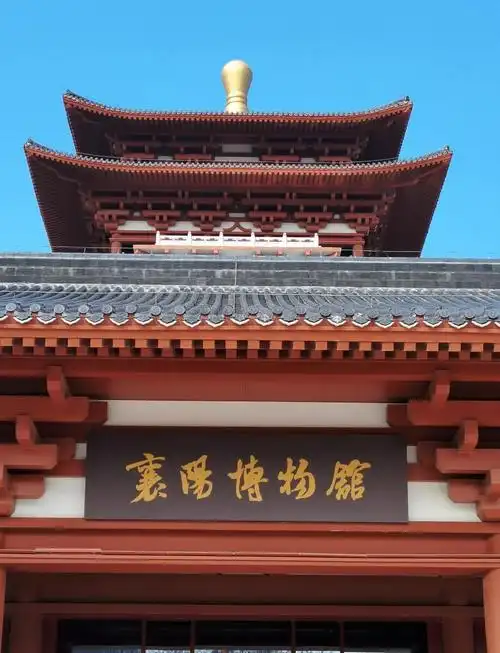
The Xiangyang Museum, a treasure where Chu culture and Han-Tang civilization converge, houses over 20,000 artifacts that form a millennia-spanning corridor through time. In the exhibition area dedicated to Chu bamboo slips, the complete system of Chu state texts from the Warring States period is vividly presented. Among them, the "Xiangyang Chu Slips," inscribed in the distinctive bird-and-insect script, record the wisdom of ancient peoples—an astonishing testament to early Chinese intellect.
In the Three Kingdoms Relics Gallery, a model of Zhuge Liang’s (Chancellor of Shu Han during the Three Kingdoms period) legendary wooden ox and flowing horse stands alongside Guan Yu’s (a famed general of Shu Han) Green Dragon Crescent Blade, together evoking the dramatic tales of the Three Kingdoms era. Nearby, groups of Han dynasty pottery figurines capture everyday life with lively expressions, while Tang dynasty gold and silver wares display the opulence of the High Tang through their intricate decorations.
Among the museum’s prized possessions is the Xiangyang-excavated version of the “Sword of King Goujian of Yue.” Though its blade bears the marks of time, its sharpness endures—a powerful symbol of the deep cultural exchange between the Chu and Yue states.
As the former seat of the ancient Xiangfan commandery, this land was where Emperor Liu Xiu (founder of the Eastern Han dynasty) launched his uprising and also inspired Xi Zaochi (a historian of the Eastern Jin dynasty) to compose his historical work "Chronicles of Han and Jin." Every artifact here quietly narrates Xiangyang’s dual legacy—as both a strategic battleground coveted by military powers and a vibrant crossroads of civilizations—allowing visitors to sense the brilliant radiance of history along its timeless river.