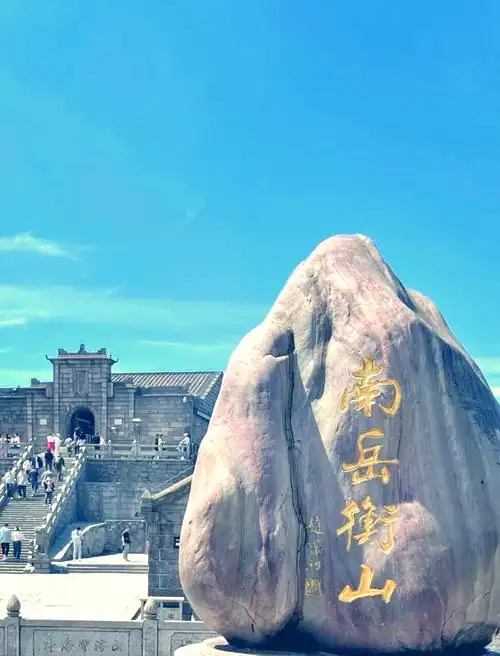
Nanyue Temple was first built during the reign of Emperor Dezong of the Tang Dynasty. Nestled at the foot of Mount Nanyue in Hengyang, it stands as the heart of Buddhist culture on Mount Heng. Its architectural complex embodies the wooden structural artistry of the Song and Ming dynasties, featuring intricately carved beams, vividly painted rafters, and colorful decorations beneath sweeping eaves and interlocking brackets. Particularly notable is its "three-courtyard, three-gate" layout, which exemplifies the aesthetic principles of classical Chinese architecture. The temple thrives with incense offerings, and its Chan (Zen) Buddhist lineage has endured for over a millennium; the resonant chants echoing through its halls bring clarity and tranquility to visitors' minds.
The central scenic area unfolds along a grand central axis. Above the main entrance hangs a plaque inscribed with “Nany Yue Da Miao” (Great Temple of Nanyue), written in the imperial hand of the Qing Dynasty, exuding solemn dignity. The Imperial Calligraphy Pavilion houses numerous plaques bestowed by emperors throughout history, including the famous “Foremost Chan Grove of Nanyue,” personally inscribed by Emperor Qianlong. The Mahavira Hall enshrines statues of the Three Buddhas of Past, Present, and Future, while the incense burner before the hall perpetually billows fragrant smoke, drawing a constant stream of pilgrims year-round. The Thousand-Buddha Hall is renowned for its murals depicting the "Jataka Tales"—stories from the previous lives of Shakyamuni Buddha—whose figures are rendered with lifelike expressions, and whose vibrant colors remain remarkably fresh despite centuries of passage.
As a unique site where Confucianism, Buddhism, and Taoism harmoniously converge, the temple has served since the Tang Dynasty as a sacred destination for poets and scholars. Wen Tianxiang, the famed Southern Song general who resisted the Yuan invasion, once composed poetry here to express his sentiments. Wang Fuzhi, the influential thinker of the late Ming and early Qing periods, also resided here for spiritual cultivation. A stone stele inscribed with “Nanyue” by Zhu Yunming, the celebrated Ming calligrapher, still stands today, while the characters “Heng Yue” (Mount Heng) penned by Zhang Xiaoxiang, the Southern Song lyricist, showcase exceptional calligraphic mastery. More than just a Buddhist sanctuary, Nanyue Temple embodies a spiritual symbol of Chinese traditional culture, bearing witness to an unbroken flame of faith spanning over a thousand years.