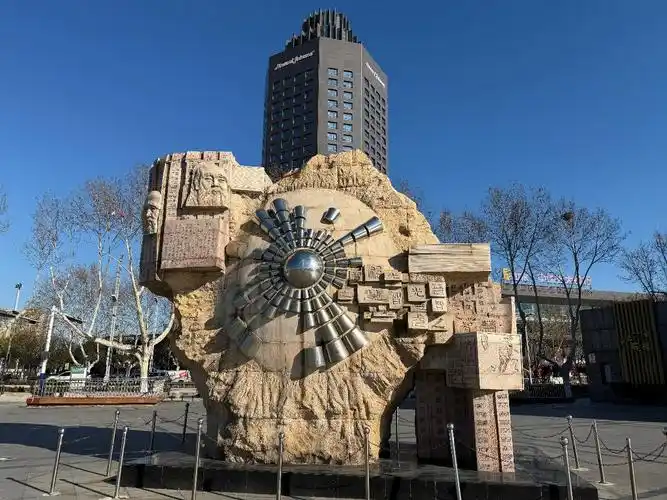
Located in Bengbu City, Anhui Province, the Huahe Culture Square is a three-dimensional cultural corridor showcasing the Huahe Civilization and the city’s spirit. The square’s core is a colossal sculpture group, utilizing the techniques of bronze casting to present a millennium-long historical scroll of Bengbu. The sculpture group depicts epic scenes, from the legendary story of Yu the Great’s flood control to the rise of modern industry, with echoes of ancient bronze bells seemingly audible amidst the interplay of light and shadow.
The square is divided into three main thematic zones. The main sculpture zone centers around “The Flowing Huahe,” with colossal bronze dragons coiled along the riverbanks, their scales inlaid with patterns from jade artifacts unearthed in Bengbu. A cultural corridor features twelve dynamic sculptures, illustrating the historical connections of Chu culture, the Grand Canal, and railway transportation, including the imposing grandeur of the sculpture “Chu Wang Wen Ding” – depicting Chu Wang Zhuang’s attempt to conquer the Central Plains during the Spring and Autumn Period. The interactive light and shadow zone utilizes holographic projection to recreate ancient water conservancy projects in Bengbu, such as Shaopibi and Zhengqunchui, showcasing the ingenuity of the ancients. Visitors can touch virtual waterways to experience the pioneering thoughts of the early inhabitants.
As an important witness to the Huahe Civilization, Bengbu has historically been a crucial north-south transportation hub. During Yu the Great’s flood control, the Huahe River was diverted here, and during the Spring and Autumn Period, the Chu Kingdom established the “Hua Yi” fortress here. Zheng He, a renowned navigator of the Ming Dynasty, once docked here before his voyages to the West. The square employs a “water vein and cultural vein” dual-narrative approach, integrating non-material cultural heritage elements such as bronze patterns, Chu lacquerware, and Bengbu ceramics into the landscape design, allowing history to awaken in light and shadow and for civilization to be passed down through interaction.