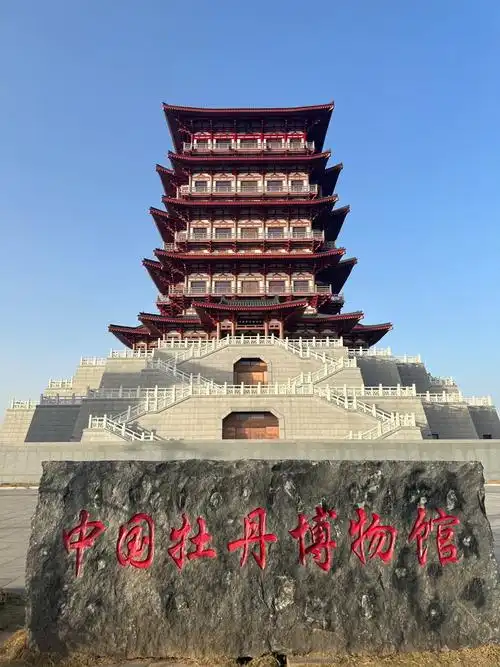
The Heze Peony Culture Museum is located in southwestern Shandong Province, the renowned "Peony Capital of China." Embodying the concept "A Thousand Years of Peony History, the Universe Encapsulated in One Museum," it masterfully blends history, art, and natural beauty. The museum houses precious ancient texts, including a fragmentary scroll of the Song Dynasty's *Peony Catalogue* and a handwritten manuscript of the Ming Dynasty's *Compendium of Flowers*. It also features meticulous reproductions of nine celebrated Tang Dynasty peony cultivars, such as 'Yao Huang' and 'Wei Zi,' reviving the timeless elegance of these "national beauties and heavenly fragrances."
Entering the main exhibition hall, "The Sacred Realm of Peonies," visitors encounter traditional-style architecture with upturned eaves adorned with hanging plaques and couplets inscribed by poets and scholars throughout Chinese history, all extolling the peony. Within the "Hall of the Peony Spirit," a manuscript of the Northern Song poet Zhang Xian’s *Ci* poem "Yi Cong Hua Ling" stands in silent dialogue across time with Qing Dynasty painter Zheng Banqiao’s (one of the "Eight Eccentrics of Yangzhou") ink painting *Ink Peony*. In the interactive zone, visitors can experience the intangible cultural heritage of "peony flower arrangement" and personally practice the cultivation techniques for "Luoyang Peonies" that date back to the Wei and Jin dynasties.
Heze has been a major center for peony cultivation since the Han Dynasty. Legend holds that Empress Wu Zetian of the Tang Dynasty initiated the tradition of "transplanting peonies into the imperial palace" here. The great Northern Song literary master Ouyang Xiu once composed his immortal verses on the "first bloom of the peony" in this very region. The museum also features a special "Peony Gene Bank," which uses 3D holographic technology to vividly reconstruct the peony’s evolutionary journey along the ancient course of the Yellow River, allowing visitors to tangibly connect with the profound cultural symbiosis between the "King of Flowers" and Chinese civilization.