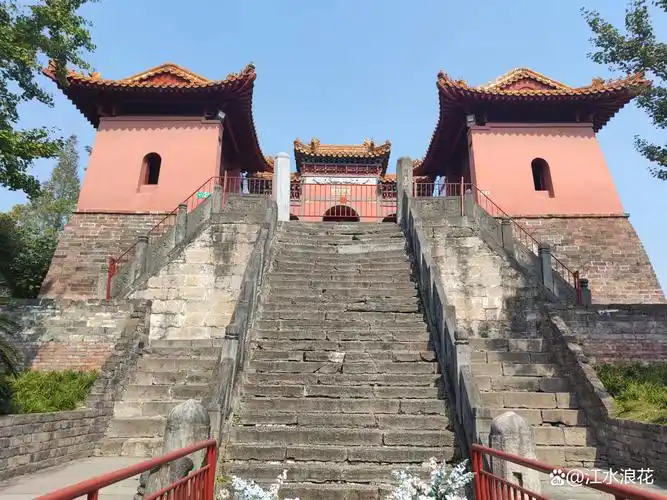
Taihui Guan is located in the eastern corner of the ancient city of Jingzhou, it is the largest existing Ming Dynasty Daoist architectural complex in the middle reaches of the Yangtze River. The site features three courtyards along a central axis, including the Three Pure Ones Hall, the Jade Emperor Hall, and the Taihui Hall, with vibrant cloud patterns painted on the eaves and brackets. The statue of the Taihui Jade Emperor within the hall is entirely gilded, creating a magnificent spectacle. On either side are guest chambers displaying fragments of the Ming Dynasty’s “Dao Zang Ji Yao” and Han Dynasty jade slips unearthed in Jingzhou. The “Xuanmen” stone carvings beside the ancient music pavilion are powerful and evocative, reflecting the number of the Eight Trigrams. According to the “Jingzhou Fu Zhi,” Taihui Guan was originally built during the Tang Dynasty’s Zhenguan period, and in the Northern Song Dynasty, Wen Yan Bo oversaw the reconstruction of the “Taihui Dao Zang.” During the Ming Dynasty’s Jiajing period, the writer Zhang Dai oversaw the reconstruction, incorporating local Jingchu customs into the architectural details, such as the bronze bells hanging from the eaves, taken from the Chu Dynasty’s bronze bells. The most valuable item within the site is the “Taihui Stele,” inscribed with Su Shi’s “Taihui Qingshe” written during his visit to Jingzhou in the Yuan Dynasty, with a powerful brushstroke resembling a dragon and snake. During the Mid-Autumn Festival, Daoists would ascend to the top of the temple to burn incense and pray for blessings, with clouds and mist creating a dreamlike landscape, attracting writers and artists to leave countless poems and stories.