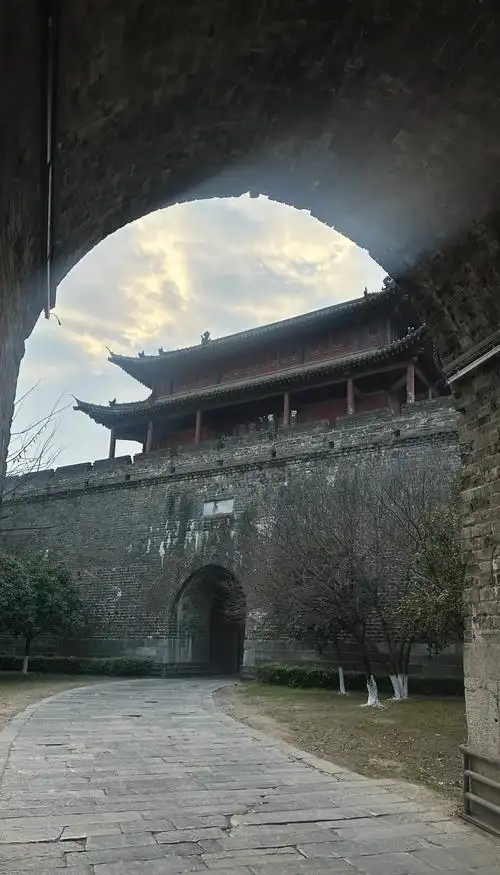
Jingzhou Ancient City Wall, the largest and best-preserved Ming-Qing era city wall in China, stands as a three-dimensional historical chronicle, etching over two millennia of profound Chu culture into its very fabric. Rising 10.5 meters high and stretching 11.6 kilometers in circumference, the wall features a rammed-earth core faced with blue bricks. Nine gates dot its perimeter like stars scattered across the sky, each accompanied by ingeniously designed barbicans embodying the military wisdom that "one man can hold the pass against ten thousand."
Strolling along the battlements, your fingertips brush against Ming-dynasty bricks fired in imperial kilns, evoking echoes of Guan Yu’s—renowned general of the Three Kingdoms—war drums during the Battle of Fancheng, where he flooded seven enemy armies, and visions of Zhang Fei’s—another famed Three Kingdoms general—banners fluttering as he guarded Jingzhou.
The moat embraces the wall, its shimmering waters reflecting the legend of the "Iron Maiden River." At the North Gate, an arrow tower preserves relics of Ming-era cannons, while the South Gate’s barbican once witnessed the poetic inspiration of Su Shi—a celebrated Northern Song dynasty writer—as he sailed along the river. Nestled within the mortar joints of the wall are the weathered yet resolute characters "Loyalty and Integrity," inscribed by Wen Tianxiang, a heroic Southern Song statesman who resisted the Yuan invasion.
From the West Gate viewing platform, one overlooks "Mist and Rain on the Jing River," one of the famed "Eight Views of Jiangling." The humid air unique to Chu lands carries the ancient, rust-tinged scent of bronze artifacts. This monumental epic in stone layers the origins of Chu, the flames of the Three Kingdoms, and the tempests of the Ming and Qing dynasties beneath visitors’ feet—each brick a fold in time, each battlement resonating with history’s enduring echo.